infocareer@admn
- Posted on
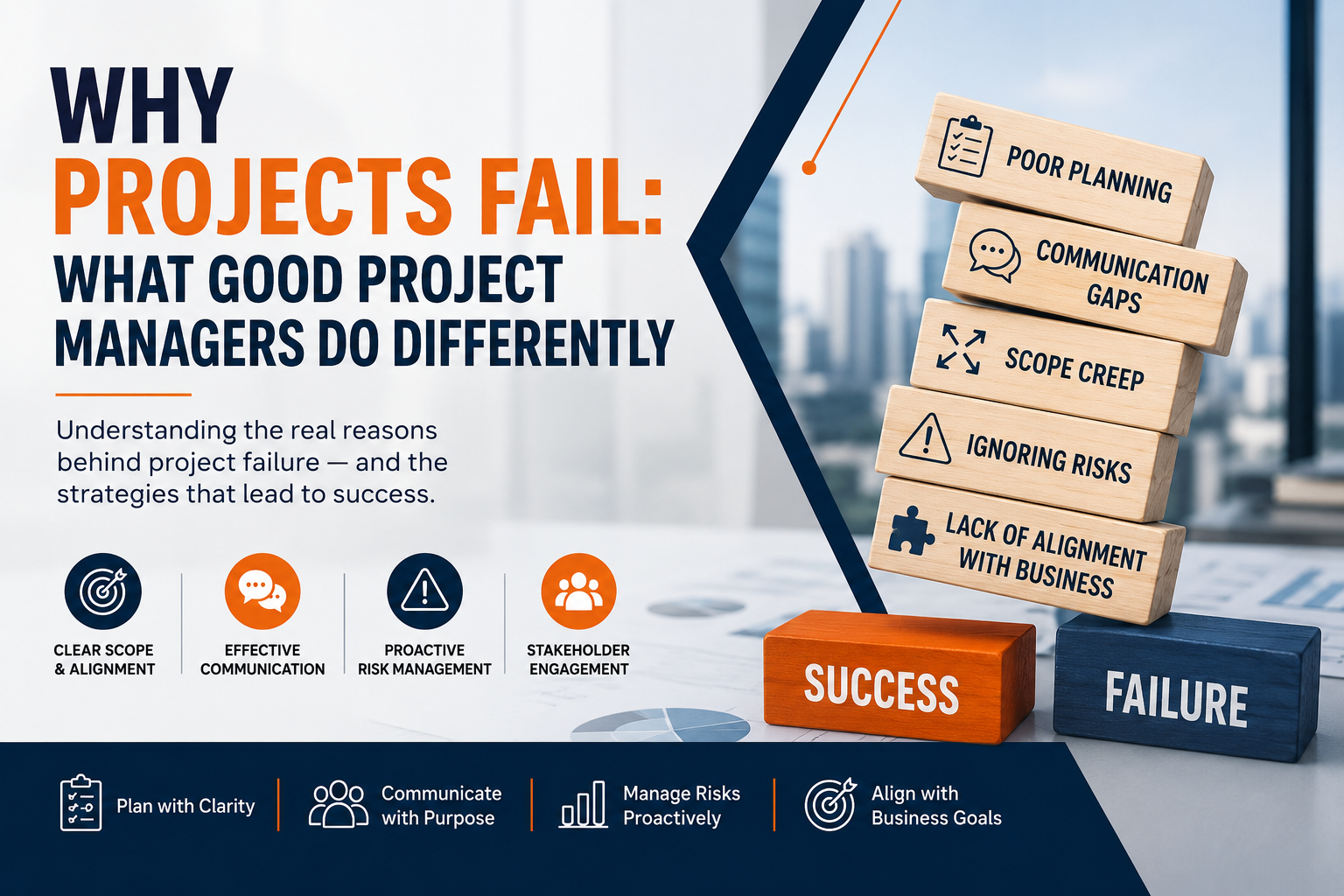
Here is a number that should stop every project manager in their tracks. Around 70% of projects fail — not because of bad luck, not because of impossible deadlines, and not because the team was incompetent. They fail because of poor planning, communication gaps, and a disconnect between what the project was delivering and what the business actually needed. If you have ever watched a project fall apart despite everyone working hard, you already know this feeling. The question worth asking is not just why projects fail — it is what the project managers who consistently deliver results are doing differently.
The Real Reasons Why Projects Fail — And Why They Are Rarely What You Think
When a project goes wrong, the instinct is to look for a single cause. A missed deadline. A stakeholder who changed their mind. A budget that got cut. But the reality of why projects fail is almost always more layered than that — and the root causes tend to show up long before anyone realises the project is in trouble.
The most critical skills for project management today include data literacy, emotional intelligence, and hybrid delivery expertise. The absence of these skills — not the absence of process — is where most project failures begin. Invensis Learning
Here are the patterns that show up most consistently:
Scope that was never truly defined. A project brief that sounds clear in week one often turns out to be a collection of assumptions by week four. Different stakeholders have different mental pictures of what success looks like, and nobody has forced that conversation to a documented conclusion. The result is scope creep — the slow, invisible expansion of deliverables that kills timelines and budgets without any single dramatic decision causing it.
Communication that runs on assumption. Most project managers send updates. Fewer project managers have genuine two-way communication with their teams and stakeholders — where problems surface early, blockers are flagged before they become crises, and the people making decisions actually understand the state of the project. Strong communication and collaboration are the foundation of successful projects. When communication fails, everything else follows. Project Management
Plans that ignore risk until it is too late. A project plan that does not account for what could go wrong is not a plan — it is an optimistic schedule. The project managers who consistently deliver results spend more time thinking about risk before the project starts than most professionals spend on it across the entire lifecycle.
Misalignment between the project and the business. This is the reason why projects fail that organisations find hardest to admit. A team can deliver exactly what was asked for — on time, on budget, within scope — and the project can still be a failure if the output does not connect to a real business need. As AI and automation handle administrative work, project managers will concentrate on more strategic responsibilities such as managing stakeholder expectations, mitigating project risks, and guiding teams through complex initiatives. The Knowledge Academy
What Good Project Managers Do at the Start That Most Professionals Skip
The gap between project managers who consistently deliver and those who consistently struggle is rarely visible during execution. It is visible at the very beginning — in how they set the project up before a single task is assigned.
They Force the Clarity Conversation Early
Good project managers do not accept a vague brief and start building a plan. They push for documented clarity on three things before anything else: what does success look like, who has authority to make decisions, and what are we explicitly not doing in this project. That last question — what is out of scope — is the one most project teams skip entirely, and it is the one that most often saves a project from scope creep later.
They Build the Risk Register Before the Project Plan
Most project teams treat risk management as a section of a document that gets filled in once and never revisited. Experienced project managers treat it as a living conversation. They identify the top five things most likely to derail the project, assign ownership for monitoring each one, and build contingency thinking into the schedule before the pressure is on.
Infocareer Tip: The best risk conversations happen before the project starts, not after the first crisis hits. If you are moving into a new project, spend thirty minutes with your team asking “what are the three things most likely to go wrong here?” before you open the project plan. The answers will change how you build the plan.
They Manage Stakeholders as Actively as They Manage Tasks
Why projects fail is often traced back to a stakeholder who was not kept informed, who felt blindsided by a decision, or who changed direction late because nobody had checked their priorities recently. Good project managers treat stakeholder management as a weekly discipline — not a kickoff activity and a final presentation with silence in between.
The Skills That Separate Consistently Successful Project Managers
Beyond core methodologies, the most critical skills for project management today include data literacy, emotional intelligence, and hybrid delivery expertise. The ability to switch between different frameworks based on project needs is essential. Invensis Learning
This matters because understanding why projects fail is not enough on its own. You need the skills to intervene at the right moment — which means reading situations accurately, communicating under pressure, and making judgment calls when the plan no longer reflects reality.
Emotional intelligence is the skill that most technical project managers underinvest in. Knowing when a team member is disengaged before it shows up in missed deadlines, knowing how to have a difficult conversation with a sponsor without destroying the relationship, knowing when to hold firm on scope and when to negotiate — these are not soft skills. They are the skills that determine whether a project survives contact with reality.
Data literacy is increasingly non-negotiable. With tools that offer real-time dashboards, KPI tracking, and predictive analytics, project managers now have everything they need to make smarter decisions at every stage. The project managers who use data to spot problems early — rather than waiting for a milestone review to reveal them — are the ones who keep projects on track. Epicflow
Hybrid delivery expertise means knowing which methodology fits which project, rather than applying the same approach to every situation. A fixed-scope infrastructure project and a product development initiative with evolving requirements need completely different approaches. Forcing one methodology onto every project is one of the most reliable ways to guarantee failure.
Why Certification Directly Addresses the Reasons Why Projects Fail
Here is the connection that matters for anyone reading this who is considering PMP or CAPM certification. The reasons why projects fail — poor scope definition, weak risk management, inadequate stakeholder communication, misalignment with business goals — are precisely the knowledge areas that certification preparation builds most deliberately.
Industry certifications like PMP, CAPM, Scrum Master, and product management credentials validate expertise while keeping professionals current. Certification pursuit opens new opportunities and increases credibility, showing dedication to professional excellence. Coursera
Certification does not guarantee perfect projects. But it gives you a repeatable mental model for the moments that matter most — when scope is drifting, when a stakeholder is going quiet, when the risk register is telling you something the schedule is not. That mental model is what separates the project managers who consistently deliver from those who are always surprised by what goes wrong.
If you are ready to build that foundation, explore our PMP Course — a mentoring-led programme built for working professionals who want to pass on their first attempt and apply what they learn immediately. You can also browse our full range of PMI Courses to find the right starting point for your experience level.
The Bottom Line
Why projects fail is not a mystery. The patterns are consistent, the warning signs are visible, and the interventions that work are documented and teachable. The project managers who consistently beat the 70% failure rate are not lucky — they are deliberate. They set projects up differently, they manage risk before it manages them, and they treat stakeholder communication as a core discipline rather than an afterthought.
The gap between a project that fails and one that delivers is almost always created at the beginning — in how clearly success was defined, how honestly risk was assessed, and how actively the people who matter were kept aligned. Fix the beginning, and the rest of the project becomes dramatically more manageable.
According to PMI, demand for skilled project management professionals is projected to reach 65 million by 2035. The professionals who will be most valued in that market are not the ones who manage tasks well — they are the ones who understand why projects fail and consistently build the conditions that prevent it.
Browse our latest blogs for more practical insights on project management, certifications, and career growth.