infocareer@admn
- Posted on
There is a quiet but significant shift happening in how the best project managers spend their time — and it has nothing to do with a new methodology or a certification update. It is about who is building the tools now. For years, if a project manager wanted to automate a report, connect two platforms, or set up an automatic notification system, they had to go to IT, raise a request, wait in a queue, and hope the output matched what they had in mind. That era is ending fast. No-code automation for project managers is one of the most talked-about practical skills of 2026 — and the professionals who build it now are pulling ahead of those who are still manually doing work that machines can handle.
What No-Code Automation for Project Managers Actually Means
Before anything else, let us clear up what no-code automation actually is — because it sounds more technical than it is.
No-code workflow automation tools let business teams build, run, and manage automated processes without writing a single line of code. Everything is built through visual drag-and-drop interfaces and preconfigured modules. WeWeb
For a project manager, this means you can build things like:
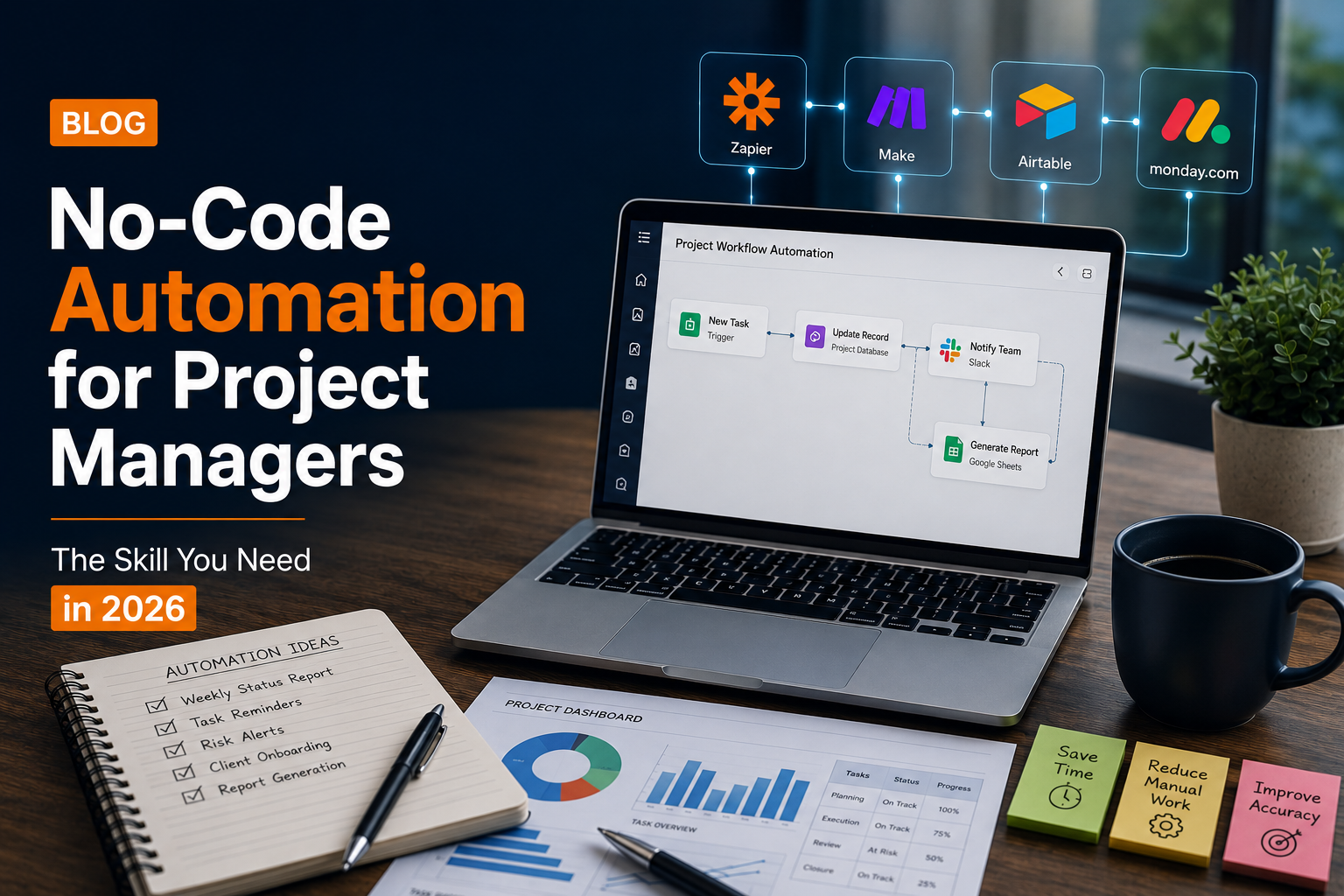
- An automatic weekly status report that pulls data from your project tool and sends a formatted summary to stakeholders every Friday morning
- A risk alert system that flags when a task has been overdue for more than 48 hours and notifies the relevant team member
- A client onboarding workflow that triggers a sequence of emails, task assignments, and document requests automatically when a new project is created
- A dashboard that pulls live data from three different tools into one view — without anyone manually copying and pasting
None of this requires a developer. Drag-and-drop workflow builders have matured enough that a billing coordinator or project manager can wire up a multi-step automation without writing a single line of code. The tools do the technical work. Your job is to understand the process well enough to design it. Creative Bits
Why No-Code Automation for Project Managers Is Exploding Right Now
The timing of this shift is not accidental. Three things are converging in 2026 to make no-code automation for project managers both possible and urgent.
The tools have caught up with the ambition. In 2026, AI is evolving from an assistant into a proactive collaborator — driven by the rise of agentic AI and no-code automation. Platforms like Zapier, monday.com, Make, and Airtable now offer levels of sophistication that previously required custom development — and they are designed for people who understand business processes, not code. FlowForma
The scale of adoption is forcing a skill reckoning. Gartner projects that over 70% of new applications developed by organisations will use no-code or low-code technologies by 2026, compared to less than 25% in 2020. When seven out of ten new business applications are being built without code, the expectation that project managers can contribute to — and lead — that process is no longer optional. this+that
The time savings are too large to ignore. Project managers who have adopted no-code automation consistently report significant reductions in time spent on manual reporting, task follow-up, and data entry. That time does not disappear — it gets redirected toward stakeholder relationships, risk thinking, and strategic decisions. Which is exactly where project manager attention should be in the first place.
Infocareer Tip: The fastest way to start with no-code automation for project managers is to identify your most repetitive weekly task and ask: “what would have to be true for this to happen automatically?” That question will tell you exactly which automation to build first. Start with one. Master it. Then build the next one.
The No-Code Tools Every Project Manager Should Know in 2026
You do not need to know every tool on the market. You need to know the ones that solve actual project management problems. Here is where to start:
Zapier is the most widely used integration platform for connecting apps without code. If you want your project management tool to talk to your email platform, your CRM, your calendar, or your reporting dashboard — Zapier is the most accessible starting point. It works on a trigger-and-action model: when X happens in one tool, Y automatically happens in another.
Monday.com automations are built into the platform most project teams already use. You can set up conditional notifications, automatic status changes, deadline reminders, and workload alerts without leaving the tool. If your team is already on monday.com, this is the fastest no-code win available to you.
Make (formerly Integromat) is more powerful than Zapier for complex multi-step workflows and handles larger data volumes more reliably. It has a steeper learning curve but gives project managers significantly more control over conditional logic and branching workflows.
Airtable sits at the intersection of database and project management tool — and its automation layer allows project managers to build custom workflows, auto-generate reports, and trigger actions based on field changes. Particularly useful for project managers who manage data-heavy initiatives.
The right tool depends on what your team already uses. The right starting point is always the workflow that costs you the most time right now.
What No-Code Automation for Project Managers Does Not Replace
Here is the honest counterpoint — because no-code automation is a tool, not a strategy.
Mental health, burnout prevention, and the human dimensions of project delivery are moving from side topics to central pillars of project management in 2026. Automation handles the mechanical. It does not handle the relational. It does not tell you when a team member is quietly disengaging. It does not navigate the politics between two stakeholders with conflicting agendas. It does not make the judgment call when a project is technically on track but strategically off course. Runn
No-code automation for project managers works best when it handles the repeatable, low-judgment tasks that eat time — freeing you up to apply more human attention to the things that actually require it. The risk is treating automation as a substitute for thinking rather than a multiplier of it. Project managers who automate the right things and spend the freed time on stakeholder management, risk thinking, and strategic alignment are the ones who see the biggest career gains from this skill.
How This Connects to Your Project Management Career
Project managers are now expected to build their own automated workflows — and this is one of the most operationally significant shifts in the profession right now. It moves capability from the IT queue to the person who actually understands the process. And that person, in most organisations, is the project manager. Unito
This skill is increasingly appearing in job descriptions, salary conversations, and performance reviews. Project managers who can demonstrate that they have built automations that save their team time, improved reporting accuracy, or reduced manual effort on a project are offering something tangible and differentiated. It is not a soft skill claim. It is a demonstrable capability.
The broader point is this: the project managers who are building career resilience in 2026 are not just the ones with the right credentials — they are the ones combining those credentials with practical digital skills. No-code automation is one of the clearest examples of that combination. It is learnable in weeks, applicable immediately, and visible in its impact.
If you are building toward a PMP or PMI certification while developing these practical skills, explore our PMP Course and our full range of PMI Courses — designed for working professionals who want credentials that connect directly to how project management is actually practised today.
The Bottom Line
No-code automation for project managers is not a future skill. It is a present one. The tools exist, the adoption is accelerating, and the project managers who have started building automated workflows are already reporting meaningful gains in time, accuracy, and their own capacity for higher-value work.
The barrier to entry has never been lower. You do not need to learn to code. You need to understand your own processes well enough to design them — which, as a project manager, you already do. That understanding is the skill. The tools are just the interface.
According to PMI, the demand for project professionals is set to reach 65 million by 2035. The ones who will lead in that landscape are not just strong on methodology — they are digitally fluent, practically capable, and continuously building the skills that make them impossible to overlook.
Browse our latest blogs for more on the skills, certifications, and career strategies shaping project management in 2026.