infocareer@admn
- Posted on
Most career advice pulls in one of two directions. Go deep — become the undisputed expert in your field. Or go broad — develop enough knowledge across enough areas to be useful anywhere. Both instincts are understandable. Both, on their own, are increasingly insufficient. The career model that is actually producing the strongest outcomes in 2026 sits in the tension between these two extremes. It has a name: the T-shaped professional. And if you are building a career that you want to last through the next decade of workplace disruption, it is worth understanding precisely what this means and why the timing of this conversation matters right now.
Why the T-Shaped Professional Career Is the Hiring Model of 2026
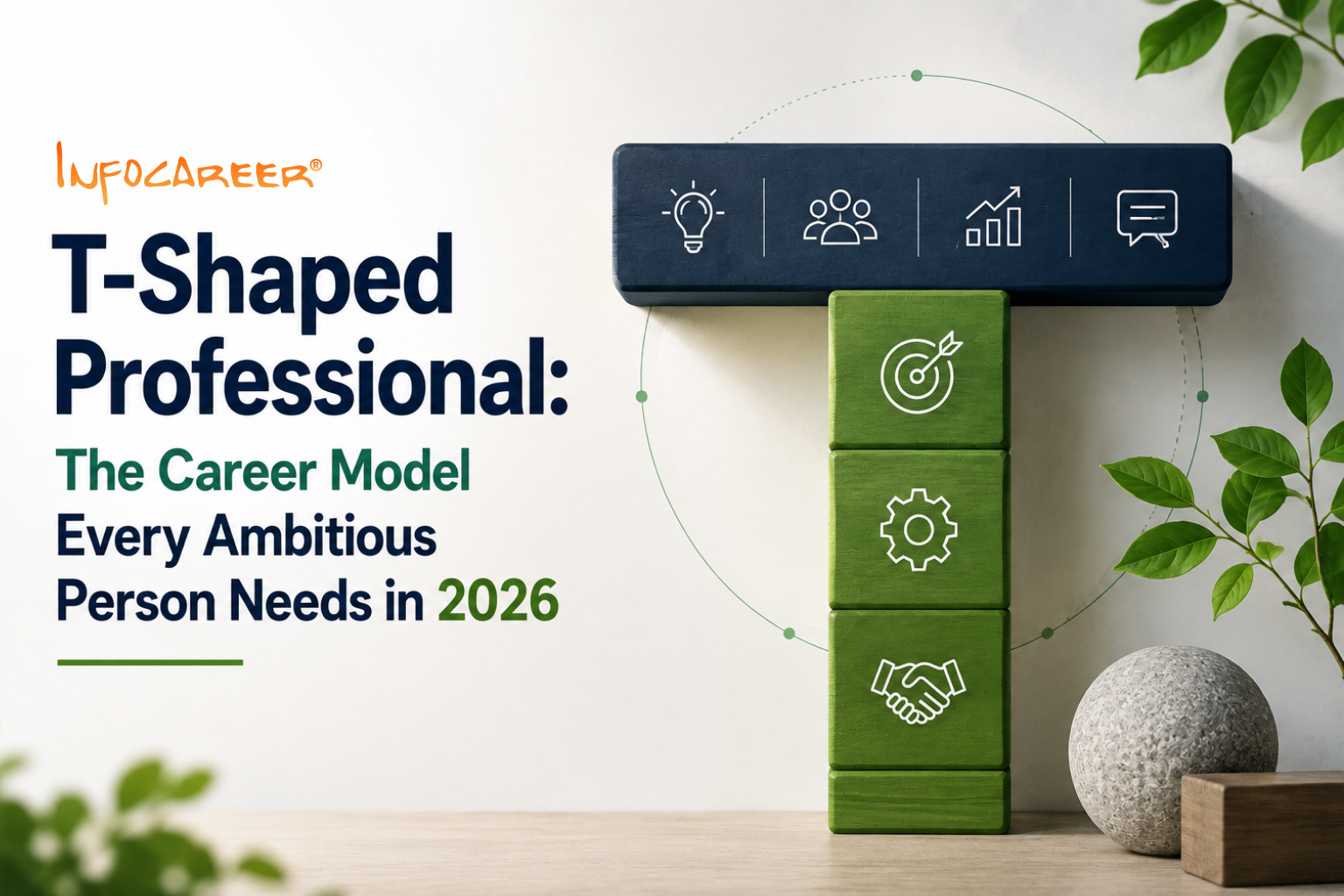
The T-shape metaphor describes a professional with genuine depth in one domain and genuine breadth across several adjacent ones. The vertical bar of the T is mastery — the area where your judgment is trusted, where people come to you, where years of focused work have produced something that is genuinely difficult to replicate. The horizontal bar is fluency — enough working knowledge across complementary disciplines to collaborate effectively, think contextually, and contribute meaningfully beyond your core lane.
This combination has always been valuable. What has changed in 2026 is that the alternative — pure depth without any breadth — has become significantly more fragile as a career strategy. AI has automated a substantial portion of the routine work that used to sit at the specialist level. The project manager who only manages tasks, the analyst who only runs standard reports, the developer who only writes code to specification — these professionals are finding their roles narrowing rather than growing. The T-shaped professional career is not a trend. It is a structural response to a permanent shift in how work gets done.
There is also an organizational dimension to this. Most companies are running leaner than they were three years ago. Smaller teams mean every professional needs to cover more ground, contribute to more conversations, and understand enough about adjacent functions to operate without constant handholding. The T-shaped professional is built for this environment in a way that the narrow specialist simply is not.
What the Horizontal Bar of a T-Shaped Professional Career Actually Contains
Breadth sounds straightforward until you try to build it deliberately — at which point most professionals discover they have been accumulating knowledge randomly rather than strategically. The horizontal bar of your T is not everything you happen to know. It is the specific set of adjacent disciplines that make your deep expertise more valuable in context.
For project management professionals, this is particularly concrete. A project manager with PMP-certified expertise whose horizontal bar includes data literacy, change management, and financial acumen is a fundamentally different proposition to an employer than one whose expertise stops at the methodology level. Data literacy means they can lead evidence-based conversations rather than just report on them. The change management knowledge means their projects actually get adopted rather than delivered and ignored. Financial acumen means they are trusted in budget conversations that usually happen above the project manager level.
This is the practical version of the T-shaped professional career — not a collection of certifications, not a LinkedIn skills section with forty-seven endorsements, but a coherent horizontal that makes the vertical demonstrably more powerful. The test of whether your breadth is genuine is whether it changes the quality of decisions you make in your core role. If it does, it belongs on your T. If it is just something you know about, it does not.
Infocareer Tip: The most common mistake professionals make when building a T-shaped career is choosing their horizontal based on what seems interesting rather than what amplifies their vertical. Map the decisions you make most often in your core role and ask which adjacent disciplines would most improve the quality of those decisions. That mapping will tell you exactly where to invest your breadth.
The Depth Side of the T-Shaped Professional Career Is Non-Negotiable
There is a version of the T-shaped professional conversation that treats depth and breadth as equally weighted — as if being reasonably knowledgeable across many areas is sufficient as long as you have a general interest in a core domain. It is not. The horizontal bar of the T has no value without a genuine vertical underneath it.
This is where certification matters more than most professionals give it credit for. A PMP or CAPM credential does not just signal that you know project management. It signals that you have reached a specific, externally validated standard of knowledge that employers and clients can rely on without having to assess it themselves. In a hiring market where everyone claims expertise, a credential is one of the few shortcuts available to demonstrate depth rather than just assert it.
The T-shaped professional career works because the depth is real and the breadth is deliberate. Remove either one, and what remains is either a narrow specialist whose lane is shrinking or a generalist whose value is unclear. The combination is what creates genuine career resilience — the kind that holds up through industry shifts, technological disruption, and economic uncertainty.
Making the T-Shaped Professional Career Visible to the Right People
Building a T-shaped profile is not enough if you cannot articulate it clearly. The professionals who benefit most from this career model are the ones who can tell a coherent story about both dimensions — the depth that makes them credible and the breadth that makes them broadly useful.
This is a practical skill and it is worth developing deliberately. In an interview, a performance review, or a pitch for a new project, the T-shaped professional does not just list their expertise. They explain how their breadth makes their depth more valuable and how their depth gives their breadth genuine weight. A project manager who can say “My PMP certification gives me the governance foundation, and my change management experience means I focus on adoption from day one” is telling a T-shaped story. That story is far more compelling than a list of qualifications.
The market for T-shaped professionals is real, and it is growing. According to PMI, demand for project professionals will reach sixty-five million by 2035. The ones who will occupy the most senior, most trusted, and most well-compensated positions in that landscape will not be the deepest specialists or the broadest generalists. They will be the ones who have built genuine depth and genuine breadth in combination — and who have made that combination visible and legible to the people making career-defining decisions.
If building your vertical is the next step, explore our PMP Course—the credential that remains the clearest signal of genuine project management expertise globally. Browse our PMI Courses to find the right entry point for your experience level.
Browse our latest blogs for more on career strategy and professional development in 2026.