infocareer@admn
- Posted on
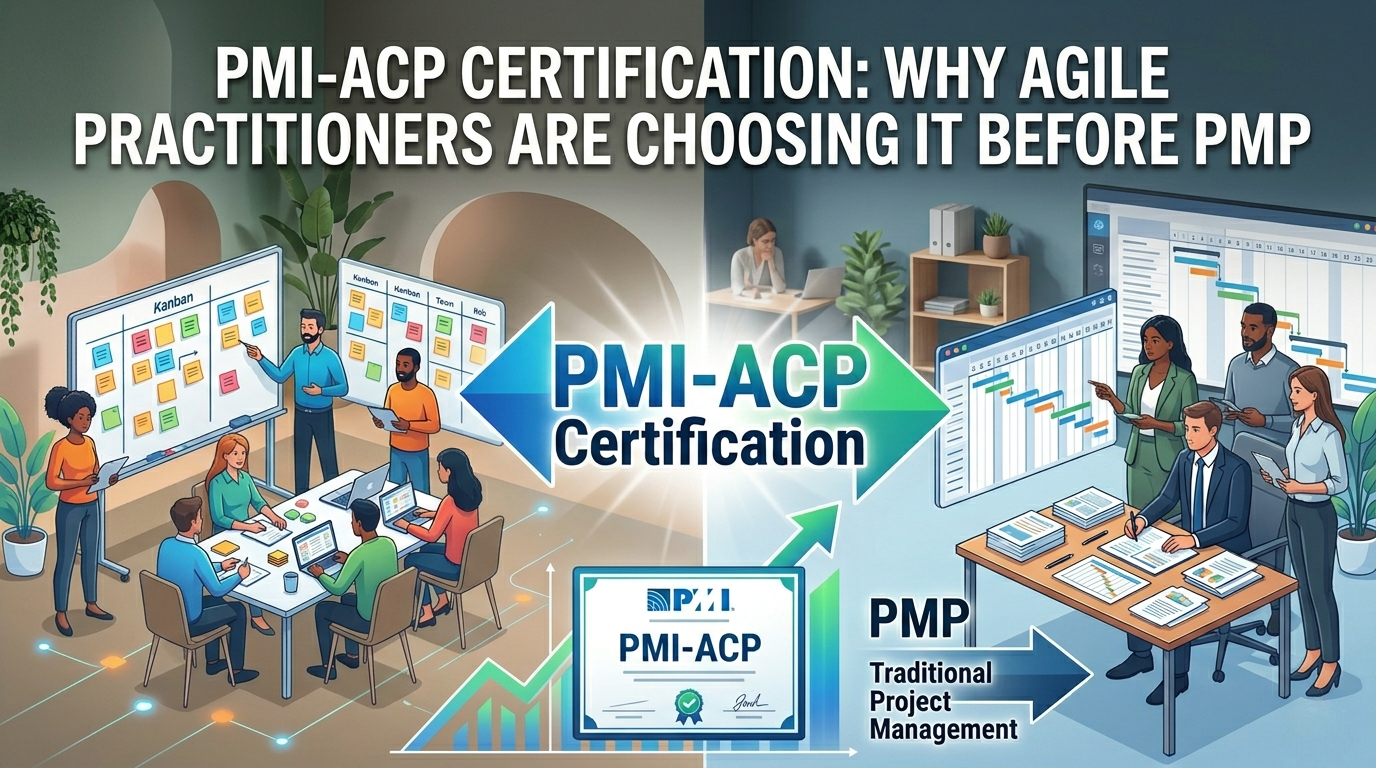
If you’ve spent the last two or three years running sprints, facilitating retrospectives, or co-owning a product backlog, chances are someone has already told you to just go get your PMP. It’s well-meaning advice, and for a lot of agile practitioners, it’s also the wrong first move. The PMI-ACP certification rarely comes up in that conversation, even though it was built specifically for the kind of work you’re already doing. While everyone defaults to the credential with the famous initials, a growing number of scrum masters, agile coaches, and product owners are quietly choosing the PMI-ACP certification first, and not because it’s “easier.”
The PMI-ACP Certification Nobody Talks About Until They Need It
The PMI-ACP certification has been around since 2011, but it still lives in PMP’s shadow in most career conversations in India. PMI built it as a framework-agnostic credential, which means it doesn’t ask you to pledge allegiance to Scrum, Kanban, Lean, or XP. It tests whether you understand agile values and principles well enough to apply the right tool to the situation in front of you, rather than how well you’ve memorised one specific methodology’s vocabulary. For anyone who has worked across more than one framework, which describes most agile practitioners by year two, that’s exactly the kind of credential that reflects the actual job.
Why Agile Practitioners Often Skip Straight to PMP, and Regret It
Most agile practitioners skip the PMI-ACP certification entirely and go straight for PMP, usually because it’s the name that shows up in job descriptions and LinkedIn headlines. The trouble starts at the application stage. PMP eligibility expects measurable hours of experience leading and directing projects, and PMI’s application wants specifics: project names, your role, what you delivered. If most of your work has happened inside two-week sprints with a product owner setting priorities, translating that into “leading and directing projects” language can feel like stretching the truth. The PMI-ACP certification doesn’t ask you to perform that translation. It asks for agile project experience in the language agile teams actually use.
What the Exam Actually Tests
The exam covers agile principles and mindset, value-driven delivery, stakeholder engagement, team performance, adaptive planning, problem detection and resolution, and continuous improvement, across 120 questions. It deliberately draws from multiple frameworks rather than testing you on one. That breadth is also why practitioners who’ve only ever worked in a single framework, say Scrum and nothing else, sometimes find the exam harder than expected. It rewards people who’ve been exposed to a mix of approaches, even informally.
PMI-ACP Certification vs PMP: It’s Not Really a Competition
Here’s where the comparison actually matters:
- Experience required: The PMI-ACP certification asks for 2,000 hours of general project experience plus 1,500 hours specifically on agile project teams within the last three years, alongside 21 contact hours of agile training. PMP asks for 36 months leading projects with a degree, or 60 months without one, plus 35 contact hours.
- Framework focus: The PMI-ACP certification stays framework-agnostic across Scrum, Kanban, Lean, and XP. PMP assumes a more traditional, plan-driven view of project leadership, even though its content has broadened over the years.
- Renewal: Both need 30 PDUs every three years, so the upkeep is similar once you’re certified.
- Who it suits: If your experience sits mostly inside agile teams, the PMI-ACP certification’s experience requirements map onto your actual work. PMP’s requirements map onto a different kind of project history.
Who Should Get the PMI-ACP Certification First
- Scrum Masters and Agile Coaches who want a credential reflecting coaching and facilitation across teams, not just one framework’s certification ladder.
- Product Owners and Business Analysts working inside agile delivery who want formal recognition without claiming traditional “project manager” experience they don’t actually have.
- Traditional Project Managers moving into agile-heavy organisations who want to demonstrate range before committing to a transformation lead title.
- Anyone targeting blended PMO or delivery roles, where job descriptions now list “agile certification preferred” right alongside PMP.
Conclusion: Our Take
Here’s where Infocareer lands on this, after watching this exact debate play out with dozens of professionals: get the PMI-ACP certification first if your last two years of work were genuinely agile, and treat PMP as the next step once you’re ready to lead programmes that blend agile and traditional delivery. Skipping straight to PMP because it’s the more recognisable name often means filling an application with experience that doesn’t quite fit, and walking into an exam that tests a way of working you haven’t actually been doing. The PMI-ACP certification isn’t a stepping stone or a lesser cousin of PMP. For agile practitioners, it’s the certification that actually matches the job.
If you’re weighing which certification path fits where you are right now, Infocareer’s mentoring-led programs work with PMI-ACP and PMP aspirants individually, not on one generic syllabus for everyone. According to PMI’s own certification handbook, eligibility hours and exam content outlines are reviewed periodically, so it’s worth checking current requirements directly before you apply.
Explore our PMP mentoring track here, or browse all PMI courses to compare options side by side. You’ll also find more career and certification breakdowns like this one on our blog.
Internal & Outbound Link Placement (insert when publishing — do not leave as plain text on WordPress)
- PMI Courses → link the phrase “browse all PMI courses” in the second-to-last paragraph to https://www.infocareerindia.com/pmi-courses/
- PMP Course → link the phrase “Explore our PMP mentoring track here” in the second-to-last paragraph to https://www.infocareerindia.com/pmp/
- All Blogs → link the phrase “more career and certification breakdowns like this one on our blog” in the final paragraph to https://www.infocareerindia.com/blogs-mentoring/
- Outbound (authoritative) → link “PMI’s own certification handbook” to PMI’s official PMI-ACP certification page: https://www.pmi.org/certifications/agile-acp