infocareer@admn
- Posted on
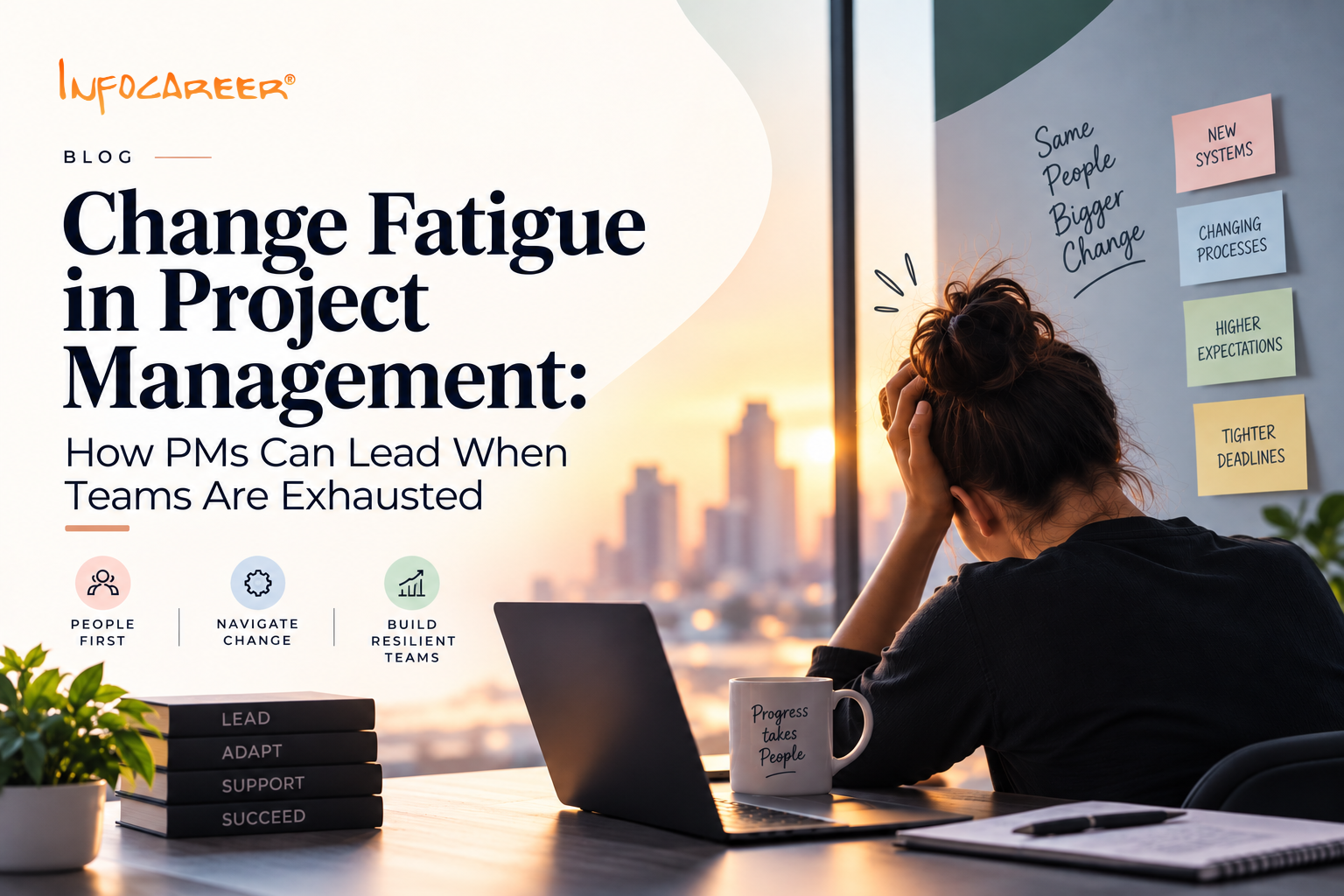
Something significant has shifted in how employees relate to change — and project managers are standing right at the centre of it. A recent analysis of over twenty million employee survey responses found the biggest recorded shift in what drives engagement at work. Belonging and feeling valued, the consistent top two engagement drivers from 2016 through 2024, have fallen to the bottom of the list. What has taken their place at the top is change management effectiveness and confidence in senior leadership. That is not a minor trend update. It is a signal that change fatigue in project management has become one of the defining leadership challenges of 2026 — and that the project managers who understand what it actually is, and what to do about it, are the ones their organisations need most right now.
What Change Fatigue in Project Management Actually Looks Like
Change fatigue is real and it does not discriminate between positive and negative change. A team that has absorbed three major system migrations in eighteen months can be just as fatigued by a fourth one — even if that fourth migration is unambiguously good — as they would be by a painful restructure. The exhaustion is not about the quality of the change. It is about the accumulation of it.
For project managers, this creates an uncomfortable reality. Most projects exist specifically to deliver change. Every new platform implemented, every process redesigned, every organisational shift executed is a change project. And the people on the receiving end of that project are, in many cases, the same people who have already absorbed multiple previous changes with varying levels of support.
Seventy-one percent of employees feel overwhelmed by the amount of change at work, and seventy-three percent of HR leaders say their employees are fatigued from change. Seventy-four percent say their managers are not equipped to lead change. That last figure is the one project managers need to sit with. The gap is not in strategy or technology. It is in the human capability to lead people through repeated disruption — which is exactly where a project manager’s role begins and ends. Mooncamp
The symptoms of change fatigue in project management are not always obvious. Teams go quiet in workshops rather than resistant. Adoption slows down without anyone explicitly refusing. People comply with new systems while quietly reverting to old behaviours when nobody is watching. Stakeholders who were supportive in the business case conversation become impossible to reach once execution begins. These are not signs of a difficult team. They are signs of a team that has run out of capacity to absorb another wave of disruption on top of everything that came before it.
Why Project Managers Are at the Centre of the Change Fatigue Crisis
Employees have shifted from asking “How can I grow here?” to “Do I believe this company will succeed, and will I succeed with it?” That shift is profound — and it places the project manager in a position that most project management training does not prepare them for. Project managers are no longer just delivery professionals. They are the human face of organisational change for the people most affected by it. Abhijit Bhaduri
As AI automates repetitive and analytical tasks, the distinct value of human capability becomes clearer. Power skills — the ability to influence without direct authority, manage complex stakeholder relationships, collaborate across hybrid teams, and maintain cohesion under pressure — are essential in 2026. PM-Partners
This is the practical reality of what change fatigue in project management demands from the people running the projects. Technical delivery skills get you to go-live. The human skills — reading the room, pacing the change, communicating in a way that builds rather than erodes trust — determine whether the change actually sticks after go-live.
Infocareer Tip: The most reliable early signal of change fatigue in project management is the quality of questions in workshops. When teams stop asking questions, it usually does not mean they understand and are satisfied. It means they have stopped engaging. If your project workshops have gone quiet, that silence is worth investigating before it becomes a failed adoption.
How Project Managers Can Address Change Fatigue Without Slowing Down
The instinct when a team is fatigued is to either push through — keep the pace, hit the deadline, worry about people later — or slow everything down to accommodate the exhaustion. Both extremes create problems. The project manager who pushes through a fatigued team produces a go-live with low adoption and high attrition. The one who stops to address fatigue without a structured approach loses momentum and credibility with sponsors.
The professionals navigating this well are doing something more nuanced. They are managing change at a portfolio level, not just project by project. When too many initiatives happen at once, people feel overwhelmed. Managing the full portfolio of active initiatives helps leaders avoid overwhelming teams and focus resources on the changes that matter most. Monday.com
For most project managers, this means having a conversation they are not used to having — not with the project team, but with the sponsor. The conversation is about change load. How many other initiatives are currently running in parallel with this one? Which teams are affected by multiple changes simultaneously? Is the timeline for this project accounting for the absorption capacity of the people receiving it, or only for the delivery capacity of the team building it?
That conversation requires courage, because it often involves pushing back on a timeline that somebody senior has already committed to. But project managers who have it early — who surface the change load risk before it becomes a failed adoption — are the ones who build the kind of trust with sponsors that creates genuine career momentum.
Communication is the other lever that most change fatigue situations reveal as insufficient. Thirty-nine percent of employees feel resistant due to a lack of understanding about why the change is happening, and thirty-eight percent are hesitant due to uncertainty about its implications. People do not resist change because they are difficult. They resist it because nobody has explained it well enough for them to feel safe. Project managers who communicate the why — not just the what and the when — reduce resistance before it calculates itself as change fatigue. Mooncamp
What Change Fatigue in Project Management Means for How You Lead
The broader implication of the change fatigue crisis is a redefinition of what project leadership actually requires. Change fatigue usually starts with saturation — too many changes at once, too little support. When change management is not embedded into business strategy, change fatigue embeds itself into the workforce instead. THoM
Project managers who understand this are starting to position change management not as a separate workstream alongside their project — something the organisational development team handles — but as a core dimension of how they run the project from day one. The technical deliverable and the human adoption of that deliverable are not two different things. They are the same thing, measured at different points in time.
This is also where certification preparation pays dividends that go beyond examination performance. PMP and PMI programmes build frameworks for stakeholder engagement, communication planning, and team dynamics that give project managers a structured approach to the human dimensions of delivery — the exact dimensions that change fatigue in project management most directly attacks.
If you are ready to build that foundation while developing the change leadership skills the market is asking for in 2026, explore our PMP Course and our full range of PMI Courses. Both are designed for working professionals who need credentials that connect directly to how project management is actually practised.
According to PMI, power skills — which include the ability to lead through change, communicate under pressure, and build stakeholder trust — are now one of the three core pillars of the updated PMP certification framework. The profession has recognised what the data confirms.
Browse our latest blogs for more on leadership, project management, and career growth in 2026.