infocareer@admn
- Posted on
There is a number that should make every project manager uncomfortable. Ninety-three percent of executives say sustainability is vital to business success. Only thirty-seven percent have actually embedded it into how their projects are planned and delivered. That gap is not a leadership problem or a strategy problem. It is a project management problem — and it is sitting on your desk whether you have acknowledged it yet or not.
Sustainability in project management has moved from a corporate responsibility add-on to a core delivery expectation. The organizations ahead of this shift are not the ones with the best ESG policy document. They are the ones whose project managers ask different questions, measure different things, and hold themselves accountable to a broader definition of what project success actually means.
Why Sustainability in Project Management Has Become Unavoidable
Projects represent roughly forty percent of global GDP. Every piece of infrastructure built, every software platform launched, every supply chain restructured is the result of a project. When you understand the scale at which project work touches the physical and social world, treating sustainability as someone else’s problem stops being a defensible position.
The pressure is coming from multiple directions simultaneously. Stakeholders, investors, and regulators now expect organisations to demonstrate responsible practice — not just profitable practice. In many markets, particularly for organisations working with public sector clients or multinationals, ESG compliance is becoming a contractual requirement rather than a voluntary commitment. Project managers who do not understand what that means for their day-to-day delivery are creating risk for their organisations without realising it.
The more uncomfortable truth is this: most of the sustainability gap described above is not happening because organizations do not care. It is happening because the people running the projects — the ones with the actual power to change how initiatives are scoped, resourced, and measured — have not yet made sustainability a personal delivery responsibility.
What Sustainability in Project Management Actually Requires on a Real Project
The reason most project managers disengage from sustainability conversations is that they tend to happen at a level of abstraction that feels disconnected from the practical realities of running a project. Net zero targets, ESG dashboards, social impact reporting — these sound like things that happen above the project level, in boardrooms and annual reports. They are not.
Sustainability in project management shows up in decisions that project managers make every week. How are suppliers selected and vetted — only on cost and delivery speed, or also on labor practices and environmental standards? When scope is being defined, who is included in that conversation — only the direct client, or also the communities and users affected by the outcome? When a project is closed, what happens to the materials, the data, the team, and the knowledge generated — or does that question never get asked at all?
These are not grand philosophical questions. They are practical project decisions that are currently made by default rather than by design. Sustainability in project management is the discipline of making them by design instead.
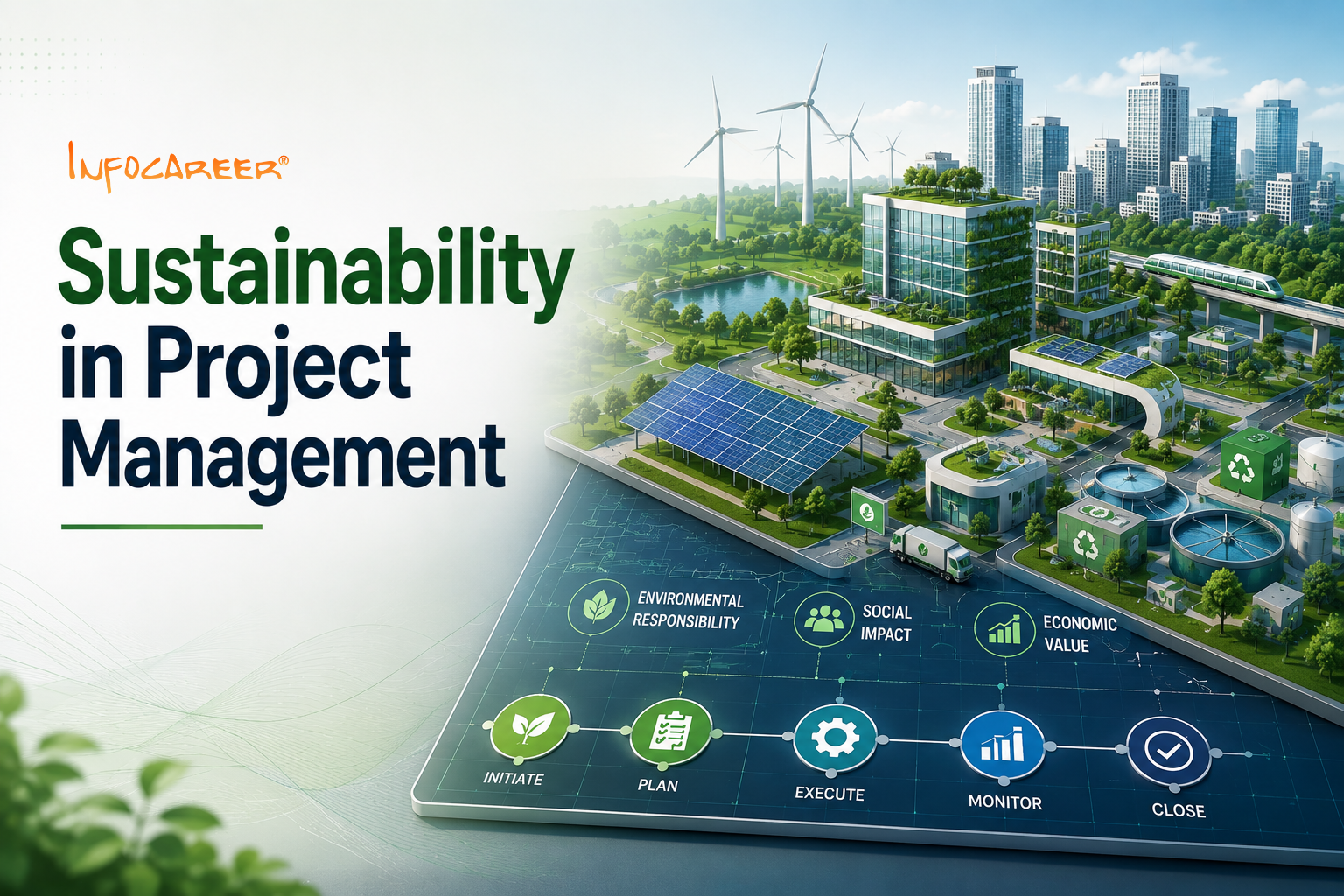
PMI defines it clearly: sustainability in project management is the strategic integration of environmental stewardship, social responsibility, and economic prosperity throughout the project lifecycle. Not at the end. Not in the reporting. Throughout.
The ESG framework gives project managers a practical structure to work within. The environmental dimension covers how a project interacts with the physical world — energy use, waste, carbon footprint, and resource consumption. The social dimension covers how a project affects people — workers in the supply chain, communities near the project site, and the diversity and inclusion practices within the team itself. The governance dimension covers how decisions are made and documented — transparent reporting, ethical procurement, and the accountability structures that ensure what was promised at the business case stage actually gets delivered.
Infocareer Tip: The simplest way to start without overhauling your entire project approach is to add three questions to your project initiation process. Who is affected by this project beyond the immediate client? What does responsible resource use look like for this specific initiative? How will we measure success beyond delivery? Those three questions will surface the sustainability considerations that actually matter for your project context — without turning initiation into a compliance exercise.
Why the Updated PMP Exam Makes Sustainability in Project Management Impossible to Ignore
If the operational and ethical arguments for sustainability have not landed yet, the examination argument might. The updated PMP exam from July 2026 tripled the weight of the Business Environment domain, and sustainability is explicitly testable content within it. Candidates are now assessed on their ability to evaluate and deliver project benefits and value — including the environmental and social dimensions of that value.
This is not a peripheral topic that appears in one or two scenario questions. It represents a fundamental shift in what PMI believes a credible project manager should know. A candidate who has treated sustainability as a box-ticking exercise will answer business environment questions differently from one who genuinely understands how project decisions ripple outward into communities, ecosystems, and long-term organizational reputation.
The connection runs deeper than examination preparation. The updated PMP content reflects what the profession is actually being asked to do. Organizations hiring certified project managers in 2026 are not just looking for someone who can manage scope, schedule, and budget. They are looking for someone who can manage the full set of outcomes a project creates — including the ones that do not appear in the project plan.
The Professionals Getting This Right Are Already Ahead
The project managers who have made sustainability in project management part of their personal practice are not doing more work. They are doing different work — earlier in the project lifecycle, with a broader set of stakeholders, and with a more complete definition of what success looks like.
They are the ones whose projects get adopted rather than delivered and ignored. They are the ones who are being trusted with increasingly complex, high-stakes initiatives because their sponsors know they think beyond the deliverable. They are the ones whose certification combined with this broader practice makes them the profile that every organisation is trying to find and struggling to fill.
The gap between executives who believe in sustainability and project managers who have embedded it is not inevitable. It closes one project at a time, by the professionals who decide their definition of delivery is wider than scope, time, and cost.
If you are preparing for PMP certification and want to build both the examination knowledge and the practical competency that the profession now demands, explore our PMP Course. Browse our full range of PMI Courses to find the right programme for your current experience level and career stage.
According to PMI, project managers can be key drivers of sustainable transformation. The question is whether you are positioning yourself to lead that shift or waiting to be told to follow it.
Browse our latest blogs for more on how the project management profession is evolving and what it means for how you work.