infocareer@admn
- Posted on
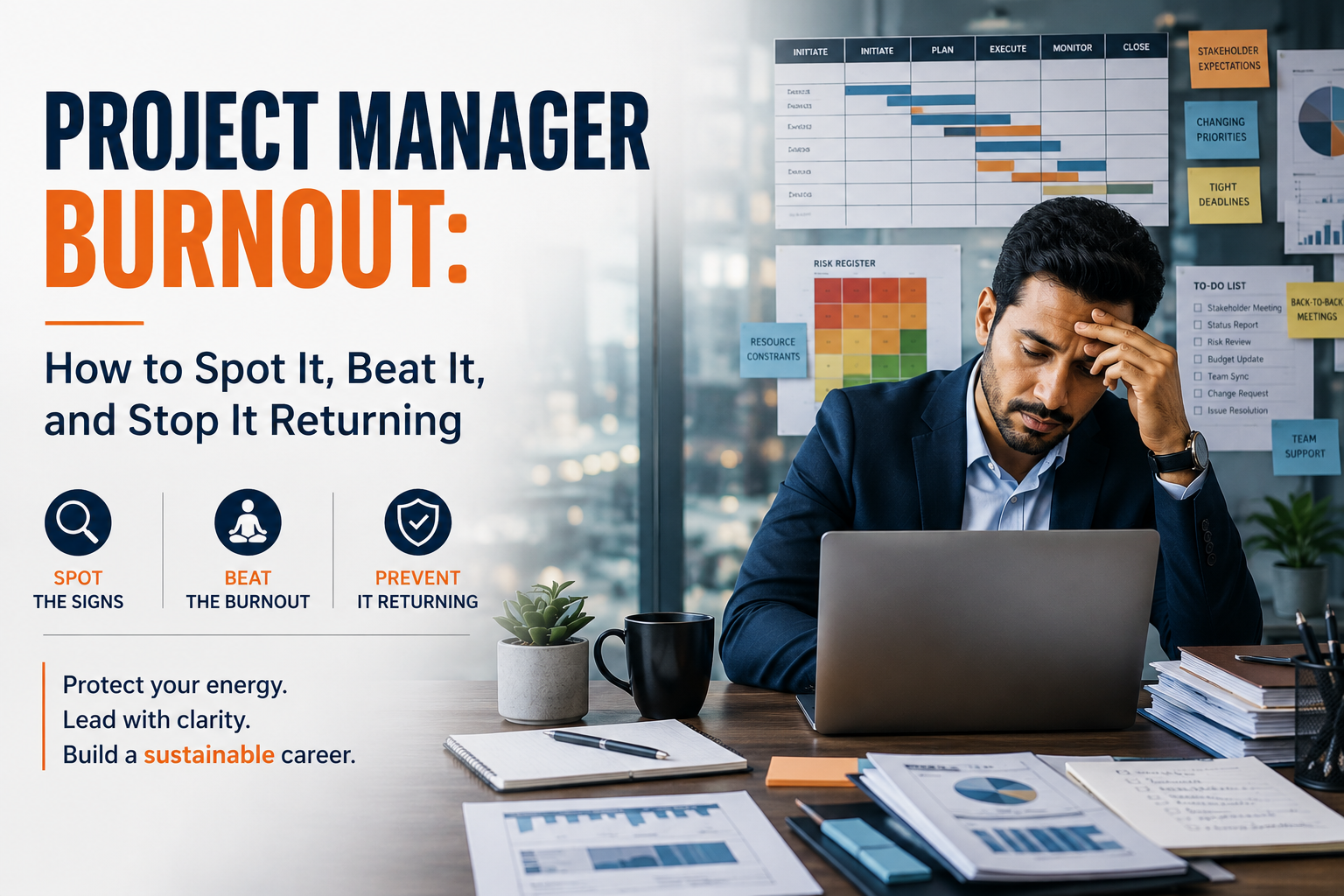
There is a version of project manager burnout that nobody talks about — the kind where you are still delivering. Deadlines are being met, meetings are attended, status reports go out on time. But internally, something has shifted. Decisions that used to feel easy now require effort you cannot quite account for. The work that once energised you feels heavier. You are present in every meeting but genuinely engaged in almost none. That quiet, gradual erosion — arriving before the collapse, invisible to everyone including sometimes yourself — is where project manager burnout actually begins. And in 2026, it is more widespread than most professionals are willing to admit.
Why Project Manager Burnout Is a Growing Crisis in 2026
Project management is consistently described as one of the most demanding professional roles. Every day, project managers balance deadlines, budgets, stakeholder expectations, changing priorities, and team dynamics — all simultaneously, and all with the expectation that nothing visibly falls apart. WorkTime
The pressure has intensified in 2026 for reasons that are structural, not personal. Project managers are now expected to deliver more value, faster, with fewer resources, while navigating uncertainty, change fatigue, and increasing stakeholder scrutiny. At the same time, the boundary between being a project manager and being accountable for business outcomes has blurred — PMs are increasingly expected to understand financial logic, adoption risk, benefit realisation, cross-functional politics, and workforce change — responsibilities that used to sit several levels above the project management role. APMICRunn
The result is a profession that is structurally overloaded. Manager engagement has dropped to just 27% globally — and 70% of team engagement variance comes directly from the manager. When a project manager burns out, it does not stay contained to one person. It radiates outward into every team interaction, every stakeholder relationship, and every project outcome. Prosci
The Warning Signs of Project Manager Burnout Most People Miss
The most deceptive thing about project manager burnout is that you may still be delivering when it begins. Deadlines are met, meetings are attended, and expectations appear to be fulfilled. But internally it feels harder. Heavier. Less sustainable. That is often the turning point — and the warning sign. Institute of Project Management
The signs worth watching for are not always dramatic:
- Decision fatigue arriving earlier in the day. When choices that used to feel routine — which risks to escalate, how to word a stakeholder update — start requiring disproportionate mental effort, that is a signal worth taking seriously.
- Emotional detachment from outcomes. When you stop caring whether the project succeeds and start caring only that your part in it is done, the disengagement has moved beyond tiredness into something more concerning.
- Loss of confidence that does not match your experience. You may notice your confidence slipping even though your experience has not changed — feeling increasingly frustrated with stakeholders and team dynamics that you have navigated successfully for years. Institute of Project Management
- Difficulty recovering between projects. Project management has always involved intense periods. The warning sign is when the recovery time between those periods stops working — when the weekend or a short break no longer restores your baseline.
Infocareer Tip: The professionals most at risk of project manager burnout are often the highest performers — the ones who have absorbed extra responsibility, covered for team gaps, and said yes to scope that stretched their capacity. If that sounds familiar, it is worth asking honestly: when did you last finish a week feeling genuinely restored rather than just less exhausted?
The Real Causes of Project Manager Burnout in 2026
Understanding why project manager burnout happens is not about assigning blame. It is about identifying the structural conditions that produce it — because those are the ones that can actually be changed.
Change fatigue is one of the primary drivers. It typically starts with saturation — too many changes at once, too little support. Over time it shows up as disengagement, scepticism, anxiety, and eventually burnout or quiet resistance. In 2026, most project managers are managing change on multiple fronts simultaneously: AI tool adoption inside their teams, shifting organisational priorities, evolving stakeholder expectations, and personal pressure to upskill continuously. Spring Health
Repeated organisational change, especially when combined with uncertainty and heavy workloads, significantly increases fatigue. Over time, this surfaces as emotional exhaustion and burnout. The organisations that are moving fastest on transformation are also, in many cases, the ones producing the highest rates of project manager burnout — because speed and support rarely scale at the same pace. Rebels Guide to PM
Three other causes consistently appear in the research:
Role ambiguity at the edges. As project management expands into strategic territory, the boundaries of the role become less clear. When a project manager is not sure what they are and are not accountable for, they tend to absorb everything — which is a direct path to overload.
Invisible workload. The administrative and relational work that project managers do — managing stakeholder anxiety, pre-empting conflicts, holding team morale together — is rarely visible in project plans or performance reviews. When invisible work is not acknowledged, it is also not managed.
Lack of psychological safety. Projects that scored in the top quartile for psychological safety had 47% higher median wellbeing scores than those in the lower quartile. When project managers do not feel safe raising problems, flagging capacity issues, or admitting uncertainty, they carry everything privately — until they cannot. Institute of Project Management
How to Recover from Project Manager Burnout Without Losing Ground
Recovery from project manager burnout is not a single intervention. It is a rebalancing — of workload, of expectations, and of how you relate to the role itself.
Start with an honest capacity audit. List everything you are currently responsible for and identify what is genuinely within the scope of your role versus what you have absorbed informally. The goal is not to shed responsibility — it is to make the invisible visible so that conversations about workload become possible.
Rebuild recovery into the schedule deliberately. Recovery does not happen automatically when you are not at your desk. It requires active design — protected time that is genuinely free from project thinking, not just physically away from a screen. The organisations that thrive choose effectiveness over urgency — and that principle applies to individual project managers too. Rebels Guide to PM
Have the conversation with your sponsor or manager. The instinct when burning out is to hide it — to keep delivering so nobody notices the strain. This instinct is understandable and counterproductive. Most sponsors, when presented with an honest capacity conversation, would rather adjust scope or timeline than lose a project manager mid-delivery.
Reconnect with what the work is actually for. Project manager burnout often involves a disconnection from purpose — the work becomes a set of tasks rather than a contribution to something meaningful. Reconnecting with the business outcome your project is serving, and why it matters, is not a soft intervention. It is one of the most effective ways to restore sustainable motivation.
How Structured Learning Helps Prevent Project Manager Burnout
This connection is not obvious, but it is real. One of the consistent findings in project management research is that professionals who operate with a clear framework — who have internalised a mental model for decision-making, risk thinking, and stakeholder management — experience significantly less cognitive overload than those improvising under pressure.
Certification preparation builds exactly that framework. The PMP and CAPM programmes do not just prepare you for an exam. They give you a repeatable, structured approach to the moments that create the most stress in project management — ambiguous scope, competing stakeholder priorities, escalating risks, team conflict. When you have a framework for those moments, they demand less of you. And when they demand less, you have more left at the end of the day.
If you are ready to build that foundation, explore our PMP Course — designed for working professionals who want to lead projects with confidence and sustainability. Browse our full range of PMI Courses to find the right programme for your current stage.
The Bottom Line
Project manager burnout is not a personal failing. It is a structural outcome — produced by roles that have expanded faster than the support around them, in organisations moving faster than their people can sustainably absorb. The professionals who navigate it best are not the ones who push through hardest. They are the ones who spot the warning signs early, make the invisible workload visible, and build recovery into their working pattern before the collapse forces it.
The work of project management matters too much — and demands too much — to be done from a place of depletion. According to PMI, the demand for skilled project professionals will reach 65 million by 2035. The ones who will lead that future are the ones building sustainable careers now — not just high-output sprints that end in exhaustion.
Browse our latest blogs for more on project management careers, leadership, and professional development.