infocareer@admn
- Posted on
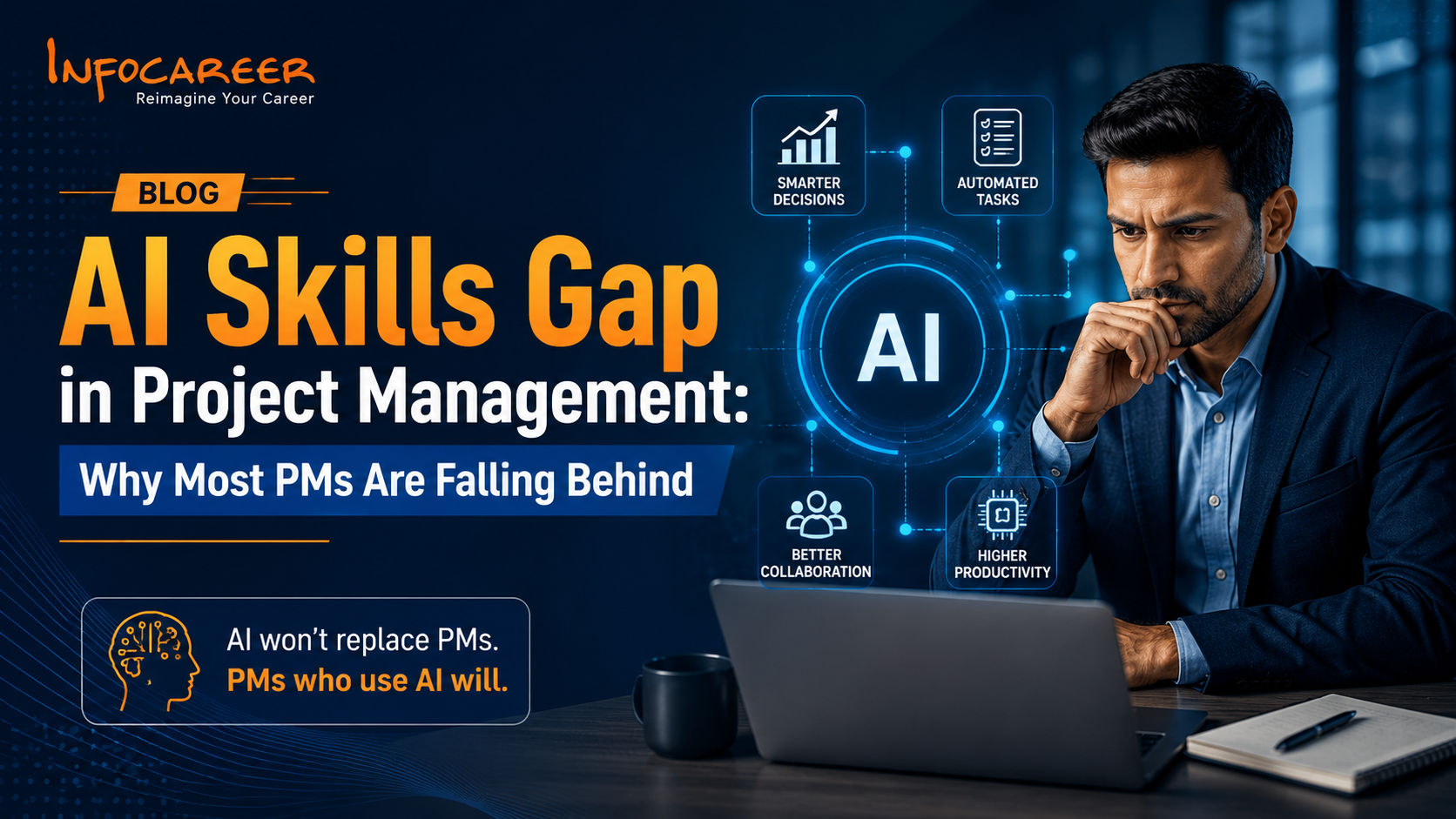
There is a number making the rounds in project management circles right now that deserves more attention than it is getting. Only 20% of project managers have meaningful practical experience with AI tools — yet 82% of senior leaders are actively planning AI integration into their project workflows. That gap between what organisations expect and what their project teams can actually deliver is not a minor misalignment. It is a career-defining fault line. And most professionals standing on the wrong side of it do not yet realise it.
The AI skills gap in project management is real, it is widening, and it is already influencing hiring decisions, salary negotiations, and who gets considered for senior roles. Here is what is actually happening — and what to do about it before the gap becomes impossible to close.
What the AI Skills Gap in Project Management Actually Looks Like
Walk into any project management conference in 2026 and the keynote slide deck looks roughly the same: an AI project assistant demo, a number suggesting most PM work will be automated by 2030, and a panel about whether project managers will still exist in five years. Then you go back to your desk on Monday morning. You still have a status report due, a stakeholder who wants a one-pager by lunch, and three risks that just escalated overnight.
The disconnect between the AI hype and the Monday morning reality is real. But here is what is also real: AI tools improve status report generation, schedule computations, and meeting transcriptions and data entry by automating 25 to 30% of project management tasks — while providing meaningful support on the remaining 70 to 75% of tasks that require judgment calls, stakeholder persuasion, ethics, and change management. Epicflow
That is not a small operational change. That is a restructuring of the working day. And the professionals who know how to use those tools are already reporting 35 to 40% higher personal productivity than those who do not.
The AI skills gap in project management is not about knowing how to code or build AI systems. It is about knowing which AI tools are worth using, how to interpret what they produce, when to override them, and how to build workflows where AI handles the mechanical work while you focus on the judgment calls. That is a learnable skill set. Most project managers simply have not started learning it yet.
Why the Gap Is Widening Faster Than Most Professionals Expect
The reason the AI skills gap in project management is widening so quickly is not that AI is moving too fast to follow. It is that adoption inside organisations is accelerating while individual learning is not keeping pace.
In 2026, AI is evolving from an assistant into a proactive collaborator — driven by the rise of agentic AI and no-code automation. Tools that once required a prompt and produced a draft are now capable of assembling team inputs, generating reports, sending them to stakeholders for approval, and saving the final version — all automatically and on a recurring schedule. PM Training School
The organisations that are moving fastest on this are not waiting for their project managers to get comfortable. They are deploying AI into workflows and expecting their teams to adapt. 44% of teams already rely on AI-assisted project management features such as automated alerts or task suggestions. If you are not seeing AI inside your PM workflow yet, you are not necessarily behind — but the gap between organisations at the frontier and those still catching up is growing every quarter. APM
Infocareer Tip: The AI skills gap in project management is not closed by reading about AI. It is closed by using AI on actual project work — starting with the lowest-risk, highest-frequency tasks. Meeting summaries, risk flag reviews, and status report drafts are the right starting point. Not because they are glamorous, but because they are where AI has moved furthest past the demo stage into genuine daily utility.
The Three Dimensions of the AI Skills Gap Project Managers Must Close
Not all AI skills are equal. The AI skills gap in project management has three distinct layers, and professionals who treat it as a single problem tend to close only one of them while remaining exposed on the others.
AI Tool Fluency
This is the most visible layer — knowing which tools exist, what they are actually good at, and how to use them in your daily workflow. It includes everything from AI-assisted scheduling and risk monitoring to generative tools for stakeholder communication and meeting documentation.
The gap here is significant. Only 20% of PMs have good practical AI experience, and 49% have little to none — yet 45% of project managers spend more than one full day per week on manual reporting that AI could automate. That is roughly 20% of the working week spent on tasks that tools already handle reliably. Closing the tool fluency gap alone frees up a meaningful amount of time for higher-value work. Research.com
AI Output Judgment
This is the layer most professionals underestimate. AI tools are not always right. They hallucinate details, miss context, and occasionally produce outputs that look authoritative but are subtly wrong. Some of the AI features released in the last 18 months are real and load-bearing. Many are demoware. The job in 2026 is telling them apart. Pmpwithray
Project managers who close this layer of the AI skills gap are the ones who know how to review AI-generated risk registers for gaps, verify AI-summarised meeting notes against actual decisions made, and push back on AI-generated schedules that do not account for team-specific constraints. This judgment is not automatic. It is built through deliberate practice and structured learning about how AI systems work and where they typically fail.
AI Governance and Ethics
This is the layer most rapidly becoming non-negotiable in enterprise environments. The Wild West era of AI implementation is ending. As AI’s influence grows, so does the scrutiny — with professional bodies launching global standards for the responsible use of AI. cplace
Project managers who understand AI governance — data privacy implications, accountability frameworks, how to document AI-assisted decisions, and when human oversight is legally required — are already more valuable than those who only know how to run the tools. This layer of the AI skills gap in project management will become a formal certification and compliance requirement in many industries within the next two years.
What Closing the AI Skills Gap Means for Your Career and Salary
The career implications of the AI skills gap in project management are already measurable. Project managers proficient in AI and data analytics are increasingly sought after, pushing average salaries upward due to their ability to handle complex AI tools and insights. Project Management
The premium on AI fluency compounds over time. Professionals who close the gap now are positioned for roles that did not exist two years ago — AI project specialist, automation coordinator, AI governance lead within a PMO — while those who wait are competing for an increasingly narrow band of roles where AI has not yet reached.
The most important insight from the current landscape is this: AI is not replacing project managers in 2026 — it is transforming them into strategic leaders who deliver even greater value. The transformation is happening with or without individual participation. The question is only whether you are shaping the change or reacting to it.
How Structured Learning Accelerates AI Skills Gap Closure
Here is the honest reality about closing the AI skills gap in project management through self-directed learning alone: it is slow, inconsistent, and leaves critical gaps — particularly in the output judgment and governance layers.
The professionals closing the gap fastest are combining hands-on AI tool experimentation with structured certification preparation that builds the strategic and governance framework underneath the tool use. PMP and PMI certification programmes are directly relevant here — the updated 2026 PMP exam now includes AI in project management and ethical AI use as testable content, which means that preparation for certification and preparation for AI fluency are increasingly the same work.
If you are serious about closing the AI skills gap in project management before it becomes a ceiling on your career, explore our PMI Courses and our dedicated PMP Programme — both designed for working professionals who need to build the strategic, technical, and governance skills the market is asking for right now.
The Bottom Line
The AI skills gap in project management is the defining professional challenge of 2026 for anyone in the field. The numbers are unambiguous: organisations are moving faster than their teams, the gap between AI-fluent and AI-naive project managers is already showing up in hiring and compensation, and the window to close the gap on your own terms — rather than under pressure — is narrowing.
The good news is that this is a closeable gap. It does not require becoming a technologist. It requires deliberate, structured effort across tool fluency, output judgment, and governance — starting now, not after the next performance review.
According to PMI, the demand for project management talent is projected to surge by 64% over the next decade. The professionals who will capture the most valuable part of that demand are the ones building AI fluency alongside their project management credentials today.
Browse our latest insights and blogs for more on how to stay ahead in an AI-driven project management landscape.