infocareer@admn
- Posted on
By Infocareer Editorial Team
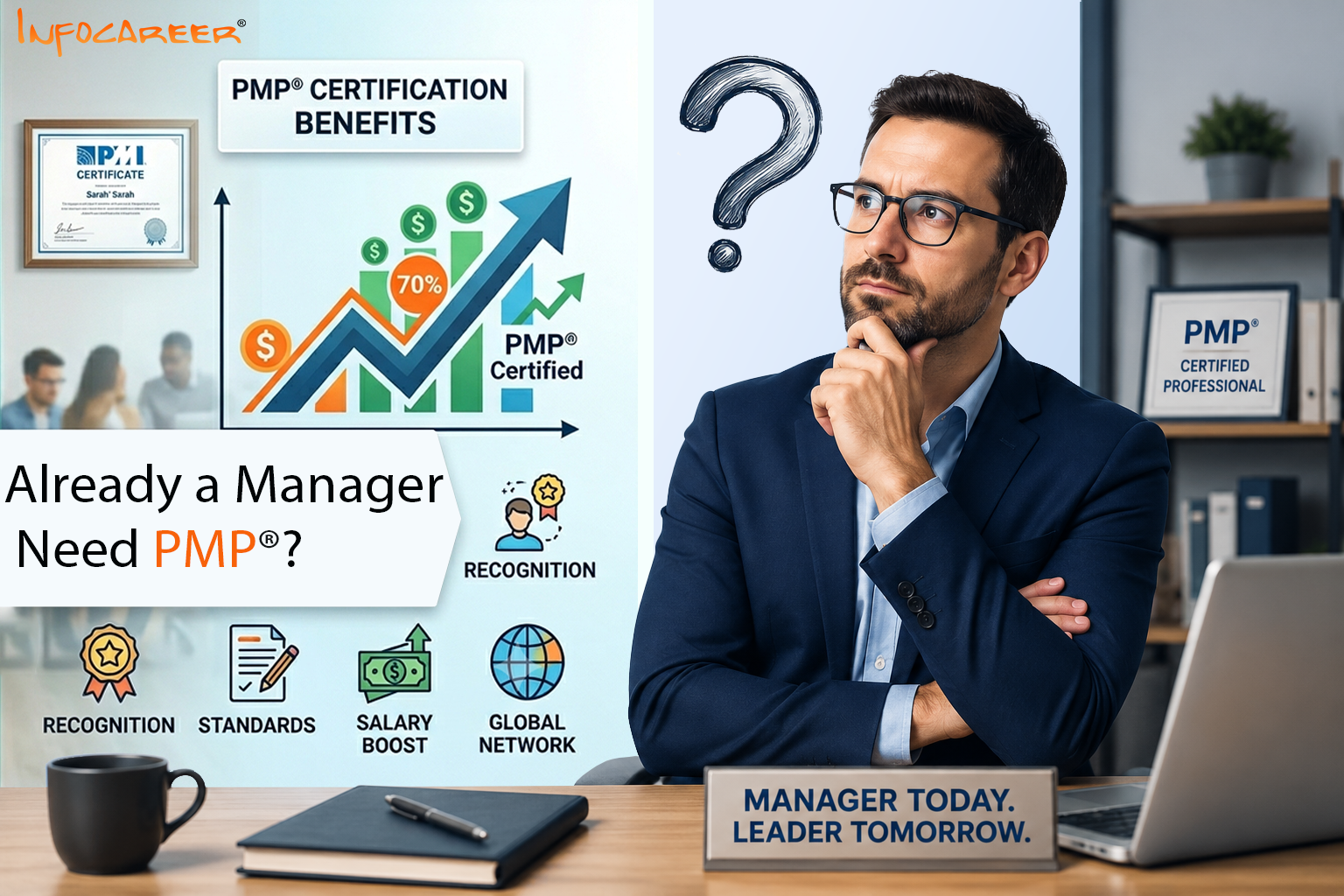
The conversation usually starts the same way. You’ve been managing projects for years. Your team delivers. Your stakeholders trust you. And then someone — a peer, a recruiter, or a job description — brings up the certification question, and you find yourself wondering whether PMP for managers like you is genuinely worth the effort or just a box-ticking exercise for people who haven’t actually been doing the work yet. It’s a fair question. And it deserves a more honest answer than “yes, everyone should have it.”
PMP for Managers: What the Question Is Really About
The pushback against PMP for managers who are already experienced tends to fall into one of three camps. The first is practical: “I’m already doing this job — why do I need a certification to prove it?” The second is cynical: “PMP is for people who want to look qualified without having real experience.” The third is strategic: “I’d rather invest that time in leadership development or a domain-specific course.”
All three are understandable. None of them are entirely right.
The real question PMP for managers is answering isn’t “can you manage projects?” You clearly can. The question it answers is whether your project management knowledge is structured, current, and legible across industries and organisations. Those are different questions. And in a competitive hiring market, the second one matters more than experienced managers usually want to admit.
What PMP Actually Changes When You’re Already a Manager
Here is what PMP for managers is not: it is not a course that teaches you how to run a meeting, write a risk log, or manage a difficult stakeholder. You already know that. What it does instead is three things that experienced managers consistently underestimate.
First, it forces you to map your actual experience against a structured framework. PMI’s application process asks you to document your project history in specific terms — scope, timelines, outcomes, your personal leadership contribution. Most experienced managers have never done that audit on their own careers. The discipline of building that application reveals gaps they did not know existed, and strengths they had stopped articulating clearly.
Second, it puts a globally portable signal on your CV. Your current employer knows your track record. Your next employer does not. PMP for managers functions as a shorthand that tells a hiring manager this person’s project management competence has been independently verified — before a single interview question is asked.
Third, the exam draws on predictive, agile, and hybrid delivery environments. Even experienced managers often find their knowledge is deep in one mode and thin in another. Exam preparation surfaces that unevenness in a way that day-to-day delivery rarely does.
The Application Process as a Career Audit
One thing that consistently surprises working managers is how much the PMI application process itself teaches them. Documenting 36 months of project leadership with specifics — not job titles, but actual deliverables, team sizes, and scope managed — forces a career retrospective that most professionals have never done formally. Several Infocareer mentees have described the application stage as more clarifying than the exam itself.
Where PMP for Managers Makes a Real Difference
The career impact of PMP for managers shows up most clearly in four situations:
- Role transitions: Moving from functional manager to programme manager, PMO lead, or delivery head almost always places PMP either as a stated requirement or an unstated expectation.
- Cross-industry moves: If you’re shifting from IT to consulting, from engineering to BFSI, or from a startup to a large enterprise, PMP for managers provides a neutral, cross-industry signal that your current employer’s reputation cannot travel with you.
- Salary negotiations: PMI’s research consistently shows salary premiums for certified professionals. In India, that premium is most visible at the senior manager and programme manager levels, where compensation conversations happen at a different scale.
- MNC and global roles: For managers targeting regional or global delivery positions at multinational organisations, PMP is frequently listed as a baseline requirement, not an added advantage.
The Honest Case Against Getting PMP as a Manager
There are genuine situations where PMP for managers is lower priority in the short term. If you’re deeply embedded in one organisation with no immediate plans to move, hold a strong internal reputation, and your work sits entirely within one methodology — pure Scrum in a product team, for example — PMP may not shift your near-term outcomes meaningfully. If your goal is narrow specialisation rather than broad delivery leadership, domain credentials may return more value in the immediate term.
But “I’m already experienced” on its own is not a reason to skip it. Experience without a credential is invisible to anyone who has not personally worked alongside you. PMP for managers makes accumulated experience legible to the wider market, and that is worth more the moment you leave your current organisation.
Conclusion: Our Honest Take
PMP for managers is not about proving you can do the job you are already doing. It is about making sure the rest of the market can actually see it. If you plan to stay exactly where you are indefinitely, the urgency is lower. But if you are serious about programme-level leadership, cross-industry mobility, or a senior delivery role at any point in the next few years, PMP is the credential that consistently appears between where experienced managers are and where they are trying to go.
According to PMI’s Pulse of the Profession report, organisations with more certified project professionals consistently deliver better project outcomes — which also tells you something about who holds the credential already and why decision-makers keep asking for it.
The managers who regret earning PMP are rare. The ones who regret waiting are not.
Infocareer’s approach to PMP preparation is built for working managers, not fresh graduates — mentoring-led, structured around your schedule, and focused on application as much as exam readiness. Explore our PMP course to see how it works, browse all PMI courses to compare the full range, or visit our blog for more career and certification thinking like this.