infocareer@admn
- Posted on
Ask any project manager which methodology they use and most will hesitate before answering. Because the honest answer is: a bit of both. Hybrid project management — the practice of blending structured planning with iterative delivery — is no longer a workaround or a compromise. It is the way most real-world projects actually run. And yet, many professionals still feel caught between two worlds, applying pure Agile or pure Waterfall to situations that neither was designed for.
This post breaks down what hybrid project management really means, why both traditional approaches fall short on their own, and how to build a blended model that works for your team, your stakeholders, and your outcomes.
What Is Hybrid Project Management?
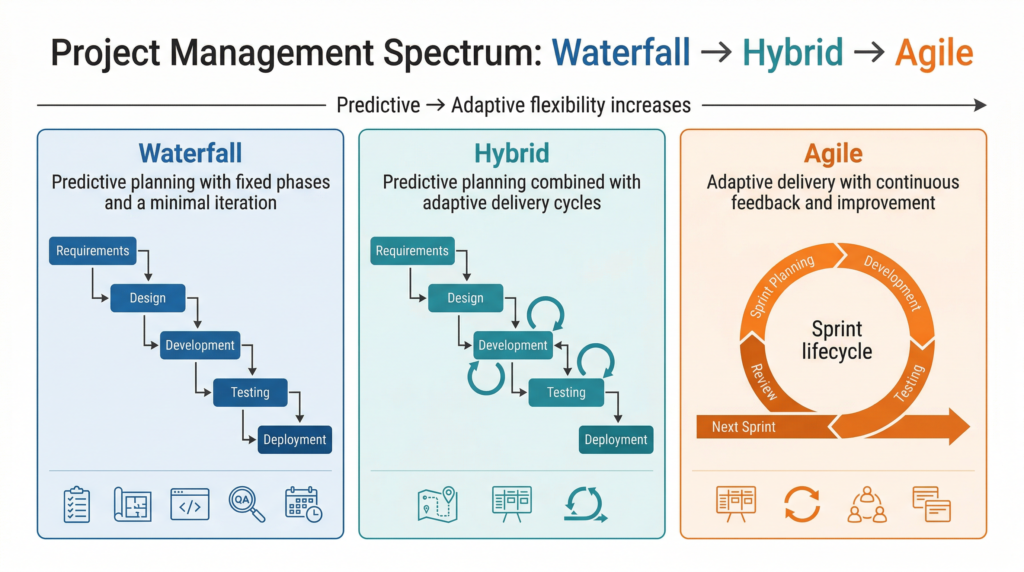
Hybrid project management is the deliberate combination of predictive (Waterfall) and adaptive (Agile) practices into a single delivery model. Rather than following one framework rigidly, a hybrid approach picks the tools and techniques that best match each phase, each team, and each stakeholder requirement.
This is not a new idea — project leaders have been improvising blended approaches for years. What is new is the formal recognition of hybrid as a legitimate methodology. The latest PMBOK and PMI guidance explicitly acknowledge hybrid delivery as a valid and often preferable model. The question is no longer whether to blend, but how to blend well.
Why Pure Waterfall Falls Short in Today’s Projects
Waterfall is built on a simple premise: define everything upfront, then execute in sequence. Requirements, design, build, test, deploy — each phase complete before the next begins. For projects where the end state is fully known and unlikely to change, this works well.
The problem is that very few projects meet that description today. Here is where pure Waterfall consistently breaks down:
- Requirements change mid-project — and Waterfall has no clean mechanism to absorb this without rework
- Stakeholder feedback arrives too late — after build, not during it
- Risk is back-loaded — problems surface at testing, not at design
- Teams operate in silos — handoffs between phases create gaps in communication and ownership
In fast-moving industries — technology, consulting, product development — a pure Waterfall model often delivers the right thing at the wrong time. By the time the project delivers, the business need has shifted.
Why Pure Agile Is Not Always the Answer Either
Agile solves many of Waterfall’s problems — it is iterative, feedback-driven, and built for change. But applying Agile without structure creates its own set of complications, especially in enterprise or regulated environments.
Pure Agile struggles when:
- Compliance and governance require documented approvals and audit trails — sprints do not produce these naturally
- Budgets and timelines are fixed — sponsors need predictability that pure iteration cannot always provide
- Teams are distributed or cross-functional — not co-located squads aligned around a product
- Senior stakeholders require milestone reporting — not sprint velocity charts
Agile is a mindset, not a prescription. Many teams adopt Agile terminology — sprints, backlogs, stand-ups — without the underlying principles, and end up with neither the structure of Waterfall nor the flexibility of true Agile. Hybrid project management addresses this directly by giving teams permission to be deliberate about which tools they use and when.
How Hybrid Project Management Works in Practice
Hybrid project management does not mean using Agile for some projects and Waterfall for others. It means using both within the same project — consciously, and in the right places.
Structure the big picture. Iterate the details.
Use Waterfall thinking for high-level project definition — scope, budget, key milestones, governance approvals. Use Agile thinking for delivery — breaking work into iterations, running retrospectives, incorporating feedback before the next phase begins. The result is a project that has clear direction and flexible execution.
Match the approach to the workstream.
Not all parts of a project carry the same level of uncertainty. Infrastructure setup might benefit from sequential planning. UX and feature development might benefit from sprint-based delivery. A hybrid project management model lets you apply the right lens to each workstream rather than forcing a single approach across the board.
Keep governance predictive, keep delivery adaptive.
Sponsors and executives often need confidence in timelines and budgets. Hybrid project management gives you a way to maintain that predictability at the reporting level while allowing the team to adapt at the delivery level. Phase gates and milestone reviews can coexist with sprint cycles — they operate at different altitudes.
Infocareer Tip: The most common mistake in hybrid project management is applying Agile at the governance level and Waterfall at the delivery level — the exact opposite of what works. Structure belongs at the top. Flexibility belongs at the execution layer.
What Hybrid Project Management Means for Certification and Career Growth
Understanding hybrid project management is no longer optional for professionals pursuing PMP or CAPM certification. The current PMP exam dedicates roughly half of its questions to agile and hybrid approaches — a significant shift from earlier versions that were almost entirely predictive.
According to the Project Management Institute (PMI), the majority of project management practitioners today work in hybrid environments, and the demand for professionals who can navigate both worlds is growing faster than supply.
This is why PMP certification training today goes well beyond memorising PMBOK processes. It builds a genuine ability to assess each project situation and design a delivery model that fits — predictive, agile, or hybrid. That situational judgement is what separates a certified project manager from a project coordinator with a title.
If you are earlier in your project management journey, CAPM certification covers the foundational concepts of hybrid delivery — enough to apply them immediately in a junior or coordinator role, and enough to build on when you are ready to pursue PMP.
Signs Your Project Needs a Hybrid Project Management Approach
You might already be in hybrid territory without calling it that. Here are the signals:
- Your sponsor wants a fixed delivery date, but requirements are still evolving
- You have a compliance or audit requirement that runs alongside iterative development
- Some team members follow Scrum while others follow a sequential process
- Your retrospectives keep surfacing the same problem: not enough structure, or not enough flexibility
- You have been told to ‘be more agile’ by leadership but ‘not lose control of the plan’
If any of these sound familiar, you are not doing project management wrong. You are doing hybrid project management without a framework to guide it. Naming it and learning to apply it deliberately is the difference between stumbling through and leading with intention.
The Bottom Line on Hybrid Project Management
The debate between Agile and Waterfall is largely over — not because one won, but because practitioners have realised the question was wrong to begin with. The right question is not which methodology to follow. It is which elements of each methodology serve this project, this team, and this set of stakeholders best.
Hybrid project management is the answer that experienced project leaders have been living for years. The frameworks and certifications are catching up. If you want to lead projects at the level the market now demands, building fluency in hybrid delivery is not optional — it is the baseline.
Explore more project management topics on our blog, or take the next step in your career with structured certification training.
Build Your Hybrid Project Management Expertise
Infocareer’s PMP and CAPM programmes train you to lead in predictive, agile, and hybrid environments — built for working professionals.