infocareer@admn
- Posted on
You’ve delivered on scope.
The timeline was met.
The budget held.
And somehow, the project still feels like it failed.
If that scenario sounds familiar, there’s a good chance stakeholder management was the missing piece.
Stakeholder management in project management isn’t a soft skill you handle on the side — it is the work. Studies by PMI consistently show that poor communication and misaligned stakeholder expectations are among the top reasons projects fail, not poor technical execution.
Yet most project managers spend 80% of their energy on plans, tools, and deliverables — and barely 20% on the people who decide whether those deliverables are accepted, celebrated, or quietly shelved.
This blog breaks down exactly what effective stakeholder management looks like in 2026, where most PMs go wrong, and how you can fix it — whether you’re preparing for your PMP exam or managing real projects right now.
What Is Stakeholder Management in Project Management?
Stakeholder management is the structured process of identifying, analysing, planning, and engaging everyone who has an interest in — or is affected by — your project.
This includes:
- Sponsors
- Clients
- Team members
- End users
- Regulators
- Vendors
- Informal influencers with decision power
PMI defines stakeholder engagement as one of the 12 principles in the PMBOK Guide, showing how critical this discipline has become.
Key activities include:
- Identifying all stakeholders — obvious and hidden
- Analysing their level of interest, influence, and potential impact
- Developing a communication and engagement plan
- Monitoring stakeholder sentiment throughout the project lifecycle
- Adjusting engagement strategies as expectations evolve
Most PMs complete only the first two steps — and stop there.
The Stakeholder Management Mistakes That Quietly Kill Projects
Treating the stakeholder register as a one-time exercise
The register gets built during initiation, filed away, and never updated again.
Meanwhile:
- stakeholders change roles
- authority shifts
- priorities evolve
- influence increases or disappears
Without periodic updates, stakeholder analysis becomes unreliable.
Confusing communication with engagement
Sending status emails is communication.
Understanding expectations before they become blockers is engagement.
This difference often determines whether a project is approved smoothly or reshaped at the final stage.
Managing up, forgetting sideways
Many PMs focus heavily on:
- sponsors
- clients
- executives
But overlook peer stakeholders such as:
- department heads
- IT teams
- finance controllers
These groups can delay delivery just as effectively as senior leadership.
Assuming silence means agreement
Silence rarely equals approval.
Sometimes it means stakeholders have disengaged and are waiting to challenge deliverables later during handover.
The Power–Interest Grid: Your Most Underused Tool for Stakeholder Management in Project Management
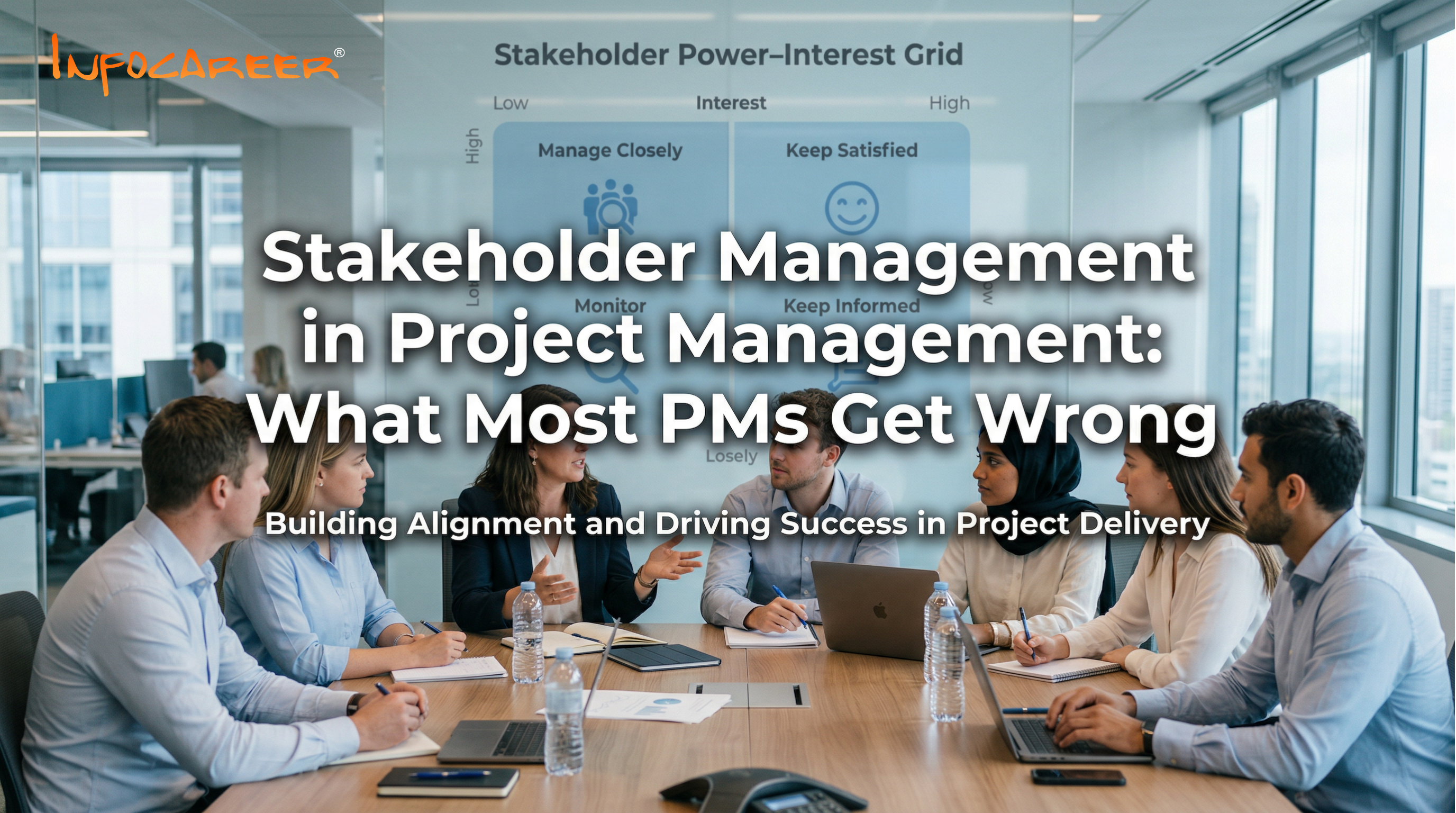
The power–interest grid (also called the influence–impact matrix) is one of the most practical tools available — and one of the least used.
It works by plotting stakeholders across two variables:
- Power — ability to influence project outcomes
- Interest — level of concern about project results
This produces four stakeholder categories:
1. High power, high interest → Manage closely
These are key decision-makers.
Use:
- regular check-ins
- early involvement
- proactive updates
2. High power, low interest → Keep satisfied
Provide concise updates.
Avoid unnecessary detail, but prevent surprises.
3. Low power, high interest → Keep informed
These stakeholders often become strong advocates when engaged properly.
4. Low power, low interest → Monitor
Minimal involvement required, but never ignore completely.
Stakeholder sentiment can shift quickly.
💡 Infocareer Tip
Rebuild your stakeholder grid at every major milestone.
On a 6-month project, positions may shift three or four times.
Stakeholder Management in Project Management Is a Core PMP Exam Domain
If you’re preparing for PMP certification, this topic carries significant exam weight.
Stakeholder management maps directly to the Stakeholder domain in the PMP Exam Content Outline.
The PMP exam evaluates your ability to:
- manage resistant stakeholders
- decide when escalation is appropriate
- rebuild trust after project disruption
- adapt engagement approaches across environments
According to PMI.org, the exam now includes predictive, agile, and hybrid stakeholder engagement approaches, meaning professionals must understand engagement differences across delivery models.
If you’re working toward certification and want structured preparation, the PMP course at Infocareer covers scenario-based stakeholder engagement aligned with exam expectations.
Explore the PMP Course:
https://www.infocareerindia.com/pmp/
How to Build a Stakeholder Engagement Plan That Actually Works
Step 1 — Identify stakeholders thoroughly
Ask:
- Who is affected by the change?
- Who controls required resources?
- Who has blocked similar initiatives earlier?
Step 2 — Analyse and prioritise
Use the power–interest grid objectively.
Avoid personal bias during classification.
Step 3 — Define engagement objectives per stakeholder
Examples:
- Sponsor → confidence in delivery capability
- End users → feeling heard during requirements gathering
Step 4 — Choose communication channel and frequency
Examples:
- weekly meetings
- fortnightly emails
- monthly executive summaries
Over-communication creates noise.
Under-communication creates uncertainty.
Step 5 — Track sentiment, not just actions
Add a sentiment column in the stakeholder register:
- supportive
- neutral
- resistant
Address changes early.
Step 6 — Adjust continuously
Engagement plans evolve with project conditions.
They are working tools, not static documents.
Stakeholder Management Across Agile and Hybrid Environments
Traditional delivery uses structured engagement schedules.
Agile delivery embeds stakeholders directly into feedback cycles.
Sprint reviews allow stakeholders to:
- evaluate working increments
- provide real-time input
- influence direction early
Hybrid environments introduce additional complexity.
PMs must translate agile progress into formats understandable to stakeholders expecting waterfall-style governance.
This requires balancing:
- transparency
- adaptability
- stakeholder expectations
- team stability
The PMI courses at Infocareer cover both predictive and agile stakeholder engagement frameworks in detail.
View all PMI Courses:
https://www.infocareerindia.com/pmi-courses/
Conclusion — The PM Who Masters Stakeholders Wins
Projects rarely fail because of schedules.
They fail when stakeholders stop believing in outcomes.
Stakeholder management is the relationship infrastructure behind delivery success.
Professionals trusted with larger initiatives are typically those who manage expectations consistently and strategically.
Start with:
- stakeholder register creation
- power–interest mapping
- milestone-level review cycles
Then deepen engagement maturity as project complexity grows.
If you want to formalise these skills through certification, PMP remains the global benchmark.
Start your PMP journey:
https://www.infocareerindia.com/pmp/