infocareer@admn
- Posted on
INTRODUCTION
You’ve probably already used AI to write a status update, summarise a meeting, or generate a project plan outline. That felt useful. Maybe even impressive.
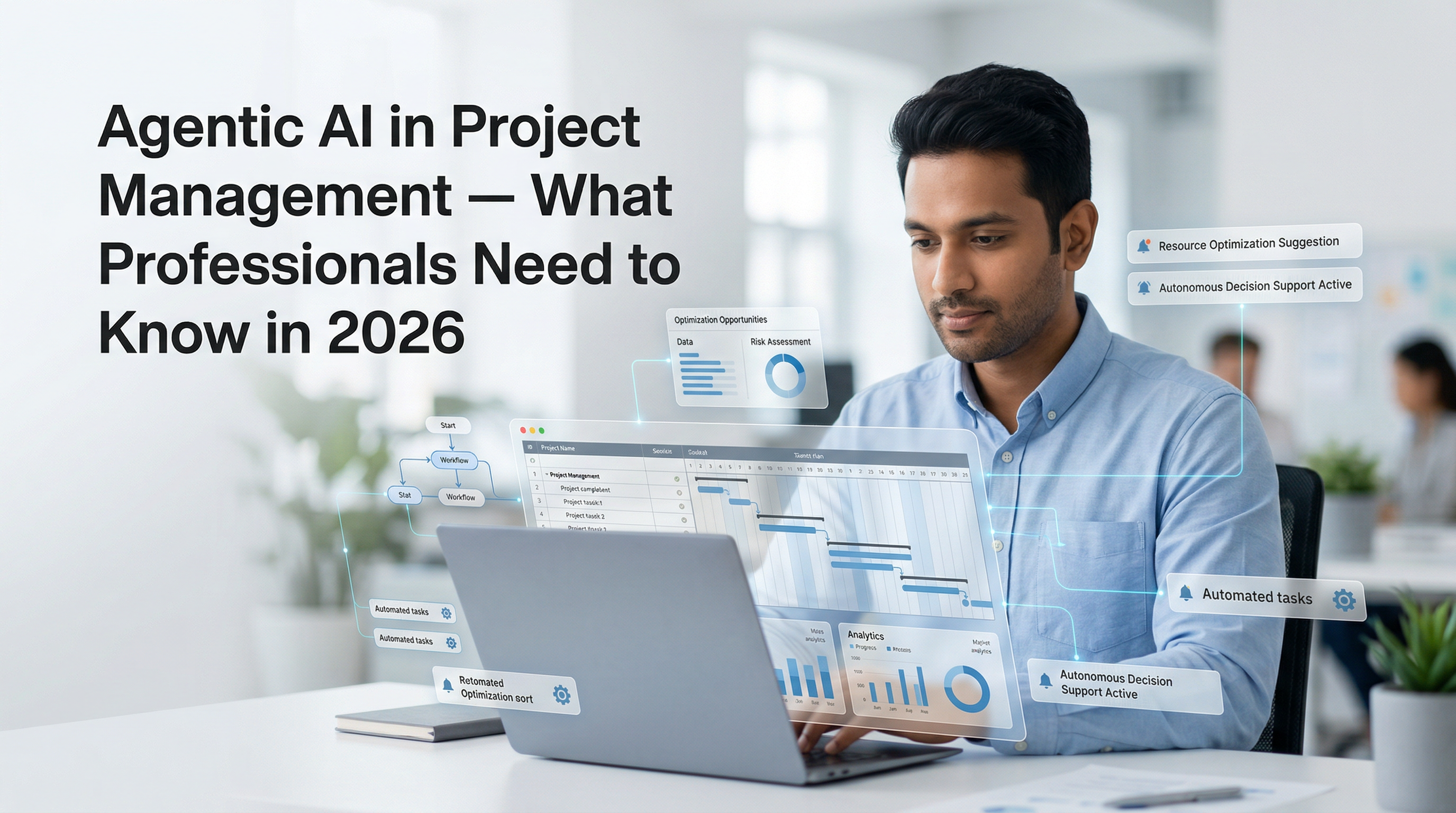
But here’s what’s happening right now that’s a completely different level: agentic AI in project management — AI that doesn’t wait to be asked. It watches your project, detects that a deadline is slipping, sends reminders to stakeholders, reassigns tasks, and updates your plan. Without you prompting it.
In February 2026, Atlassian launched AI agents directly inside Jira — agents that can be assigned a ticket alongside a human team member and execute the work themselves. Wrike launched autonomous AI agents that run multi-step workflows without human prompting. Monday.com released its “Digital Workforce” agents that monitor hundreds of projects simultaneously and flag issues in real time.
This isn’t a future prediction. It’s already running in real project environments right now.
If you’re a project manager — aspiring, working, or certified — this is the shift you need to understand before it redefines what your job looks like.
What Is Agentic AI in Project Management?
Most PMs have encountered generative AI — tools that respond when you ask them something. You type a prompt, you get an output. You’re still in control.
Agentic AI is different. It operates autonomously. It plans multi-step workflows, makes decisions within defined boundaries, and takes action without needing you to initiate every step.
Think of the difference this way:
- Generative AI: You ask “draft a risk report for this project” → it gives you a draft
- Agentic AI: It monitors your project continuously, identifies an emerging risk before you spot it, drafts the escalation, and notifies the right stakeholder — all on its own
According to PMI’s research, 80% of project managers’ routine task work could be automated by 2030. Agentic AI is what makes that possible — not by replacing judgment, but by removing the administrative load that consumes it.
What Agentic AI Can Actually Do on a Live Project
Here’s what agentic AI systems are doing inside real PM tools right now:
- Monitoring task progress across teams and flagging delays before they cascade
- Automatically reassigning work when a resource is overloaded
- Sending targeted reminders to stakeholders without the PM needing to chase
- Triaging new project intake requests and categorising them by priority
- Generating status reports by pulling live data from multiple sources
- Running what-if scenario analysis when timelines shift
- Logging decisions and actions inside the project’s audit trail just like a human team member
This last point matters: agentic AI in tools like Wrike operates inside the same governance and permission structure as your human contributors. It isn’t a black box. Every action is logged and traceable.
Why Agentic AI in Project Management Changes Your Role — Not Eliminates It
Here’s where many professionals feel the anxiety kick in. If AI can monitor, report, reassign, and escalate — what exactly does the project manager do?
The honest answer: you do more of what AI cannot do.
Research from McKinsey and PMI consistently shows that well-implemented AI can lift team productivity by up to 30%. But that productivity gain comes with a condition — it requires a human project manager who can interpret AI outputs, exercise judgment in ambiguous situations, manage stakeholder trust, and lead people through change.
Agentic AI removes the operational layer of PM work:
- Status chasing
- Report formatting
- Routine escalations
- Data gathering
It handles the work that, if we’re honest, was always the least valuable part of the job.
What it cannot do:
- Understand the political dynamics of a stakeholder relationship
- Know when a team member needs encouragement, not a task nudge
- Make an ethical call when two outcomes look equally valid on paper
- Build the trust that makes a client say yes to the next project
The PM role in 2026 is becoming strategic by default. Not by choice — by necessity. AI is taking the administrative layer. The human layer is moving up.
The Skill Stack PMs Need Right Now
If agentic AI is handling more of the operational work, the skills that protect your career are:
- AI Literacy — Understanding what agentic AI can and cannot do, and how to configure and supervise it intelligently
- Data Interpretation — Reading AI-generated insights and knowing when to trust them and when to override
- Strategic Thinking — Translating project outcomes into business value, not just delivery metrics
- Power Skills — Communication, stakeholder management, empathy, and leadership under uncertainty
- Governance Awareness — Understanding how AI actions are logged, audited, and accountability is maintained
The Tools Leading the Agentic AI Shift in 2026
You don’t need to wait for the future. These are live, commercially available tools already deploying agentic AI in project environments:
Jira (Atlassian Rovo Agents)
As of February 2026, Rovo agents can be assigned Jira tickets directly alongside humans. The agent executes tasks, logs actions, and updates status inside the same governance structure as the team.
Wrike
Launched AI agents in early 2026, including an out-of-the-box risk agent, triage agent, and intake agent. A no-code agent builder allows teams to create custom agents without IT involvement.
Monday.com Digital Workforce
The Project Analyzer agent monitors projects in real time, surfaces bottlenecks, and provides insights without prompting. The Sidekick agent serves as the interaction layer.
ClickUp Brain
Provides AI-driven workspace management, summarising project data and generating updates on demand. Supports AI agents for task automation triggered by natural language prompts.
Asana AI Studio
Focuses on reducing alert fatigue through intelligent workflow automation, ensuring the right people see the right information at the right time.
The common theme across all of them: AI is no longer just a feature. It’s becoming a team member with its own role, permissions, and accountability trail.
INFOCAREER TIP:
Don’t try to implement five AI tools at once. Pick the one narrow workflow that costs your team the most time right now — status reporting, risk flagging, or task intake — and pilot one agent on that single workflow. Master it, measure it, then expand. The PMs who fumble AI adoption do so because they go wide before they go deep.
What This Means for PMP-Certified and Certification-Aspiring Professionals
Here’s the question that matters most for Infocareer’s audience: does the rise of agentic AI in project management make certification more or less valuable?
More. Significantly more.
Here’s why:
As AI takes over the routine operational tasks, the demand for project managers who can lead, govern, and make high-stakes decisions grows. Certification signals exactly that capacity. A PMP-certified PM isn’t someone who can chase status updates. They’re someone who can manage complex environments, lead cross-functional teams, and deliver business outcomes — the capabilities that agentic AI cannot replicate.
PMI has already responded to this shift. Their PMI-CPMAI certification (Certified Project Management AI Practitioner) is now fully available through PMI following their acquisition of Cognilytica in 2024. It equips PMs to manage AI-driven projects and use AI tools responsibly.
For professionals pursuing PMP certification, the exam content has been updated to reflect hybrid, agile, and predictive approaches — all of which are increasingly delivered in AI-augmented environments. Understanding how agentic AI fits into those delivery models is becoming part of what examiners expect you to know.
If you’re currently working toward your PMP or considering it, this is the right moment. The certification validates the skills that AI can’t replace.
How to Start Using Agentic AI in Your Projects This Week
You don’t need a full AI transformation roadmap to start. Here’s a practical entry point:
Step 1 — Audit where your time goes
Before adopting any tool, track one week of your project work. How much time goes to status reporting? Chasing updates? Formatting decks? That’s your target zone for AI.
Step 2 — Start with your existing tools
If your team already uses Jira, Asana, ClickUp, or Monday.com — check what AI features are already live. You’re probably not using 60% of what’s available.
Step 3 — Run one agent on one workflow
Pick the highest-time-cost, lowest-judgment workflow. Configure one AI agent to handle it. Run it in parallel with your current process for two weeks. Compare the output.
Step 4 — Build governance before you scale
Before you expand AI usage, agree on: What can the agent do autonomously? What requires human approval? How are AI actions logged? This isn’t bureaucracy — it’s how you maintain accountability when things go wrong.
Step 5 — Upskill alongside implementation
AI tools evolve fast. The PMs staying ahead are the ones treating AI literacy as a continuous skill, not a one-time training exercise. Formal certification — PMP, PMI-CPMAI, or both — provides the structured framework to apply AI judgment responsibly.
Conclusion — The Agentic AI Window Is Open Right Now
Agentic AI in project management is not a coming disruption. It’s a current one. The tools are live, the companies are deploying them, and the project managers who understand how to work with these systems are already pulling ahead.
The professionals who will struggle are not the ones who are slow to adopt every new tool. They’re the ones who are waiting to understand what’s happening before they act — and by then, the fluency gap will be hard to close.
The good news? The skills and credentials that protect your career in an agentic AI world are exactly the ones project management training and certification have always built:
- Strategic thinking
- Stakeholder leadership
- Structured decision-making
- Governance
- Human judgment
AI handles the operational layer. You own the strategic one.
Ready to future-proof your PM career?
Explore our PMP Certification Programme → https://www.infocareerindia.com/pmp/
Browse all PMI Courses → https://www.infocareerindia.com/pmi-courses/